What it is and what it does
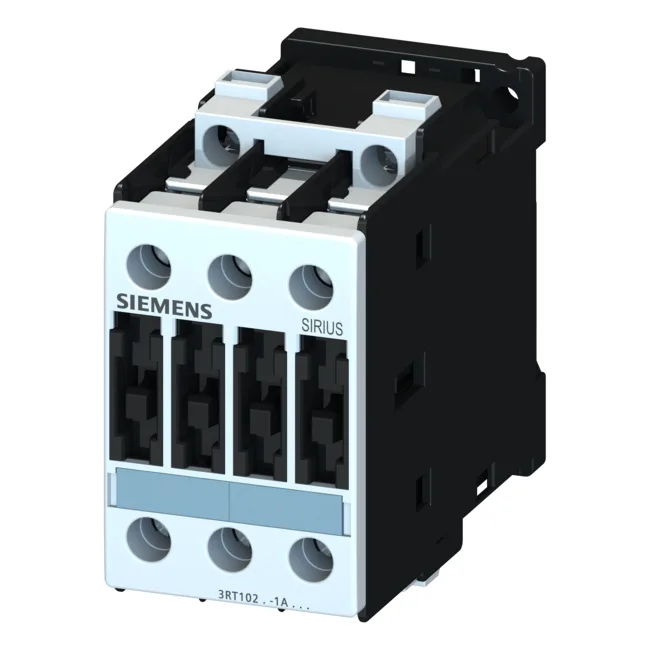
The Siemens 3RT1026-1AH04 is a SIRIUS power contactor in the S0 frame size, designed for switching three-phase motor loads in industrial control panels. It carries three normally-open main contacts and is rated for 11 kW at both 500 V and 690 V AC-3 duty, which covers the majority of standard low-voltage induction motors in European and export panels. The AC-4 rating of 15.5 A at 400 V tells you the inching/jogging capability — useful when the contactor sees frequent plugging or reversing service. Mounting is via screw or snap-on onto a 35 mm DIN rail per EN 50022, so it integrates directly into a standard panel layout without adapter plates. The 45 mm width matches the S0 footprint, allowing side-by-side mounting without derating when ambient stays within the -25 to +60 °C operating range.
Termination and wiring
Main circuit terminals are screw-type, accepting solid conductors from 2x (0.5 to 1.5 mm²) up to 2x (0.75 to 4 mm²), with a maximum of 2x 4 mm² per clamp. For stranded wire, the range is 2x (1 to 2.5 mm²) up to 2x (2.5 to 6 mm²), max 2x 10 mm². AWG equivalents are 2x (16 to 12) and 2x (14 to 10), with a single 8 AWG maximum. This covers typical motor feeder cables up to about 4 mm² for the S0 frame. The front face carries IP20 protection, adequate for enclosed panel mounting where accidental finger contact is the concern. The terminal area itself is rated IP00, meaning the wiring compartment is not touch-safe when the panel door is open — standard for this class of contactor.
Coordination and protection
For Type 2 coordination (no damage to the contactor after a short circuit), the required upstream fuse is gL/gG 35 A. For Type 1 coordination (contactor may need replacement after a fault), the fuse can be up to 100 A gL/gG. This matters when you're coordinating with a motor protection circuit breaker or selecting a backup fuse for a branch circuit. The contactor is rated for pollution degree 3, meaning it's suitable for industrial environments with conductive pollution or dry non-conductive pollution that becomes conductive due to condensation. Maximum operating altitude is 2 000 m without derating.
