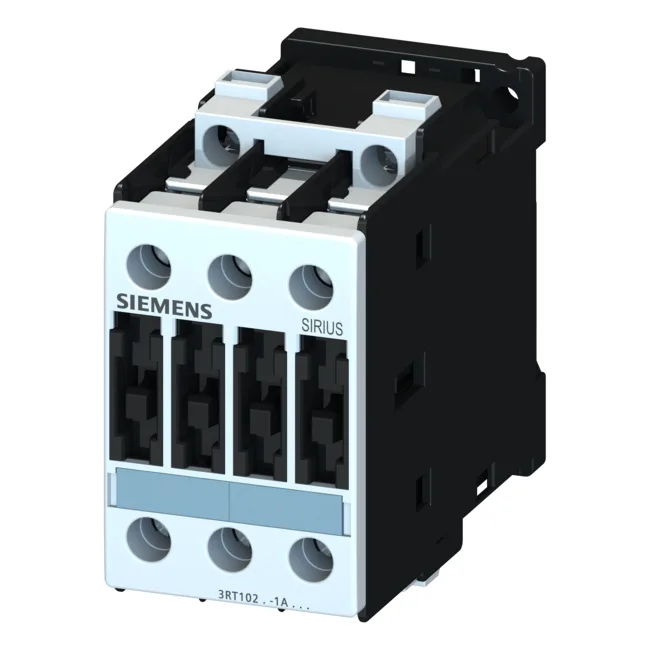
The coil operates at 50 Hz (0.8–1.1 × rated voltage) and 60 Hz (0.85–1.1 × rated voltage), so it works on either mains frequency without a coil swap.
Mounting, wiring, and coordination
Main circuit terminals are screw-type, accepting 2× (0.5–1.5 mm²), 2× (0.75–2.5 mm²), or max 2× (0.75–4 mm²) solid, and 2× (1–2.5 mm²), 2× (2.5–6 mm²), or max 2× 10 mm² stranded. AWG equivalents are 2× (16–12), 2× (14–10), or 1× 8 for the main contacts. For Type 2 coordination (no-weld after fault), the required backup fuse is gL/gG 35 A. For Type 1 coordination (welding allowed but no fire risk), the fuse can be gL/gG 100 A. This lets the panel designer choose the protection philosophy.
Auxiliary contact ratings and life
The built-in auxiliary contact is rated 10 A at 24 V, 6 A at 230 V, and 3 A at 400 V for AC loads. DC ratings are 2 A at 60 V, 1 A at 110 V, and 0.3 A at 220 V. These cover typical PLC input and relay coil switching within the contactor's own control circuit. The front of the contactor carries an IP20 rating (finger-safe), while the terminal area is IP00 — the panel enclosure provides the overall protection.