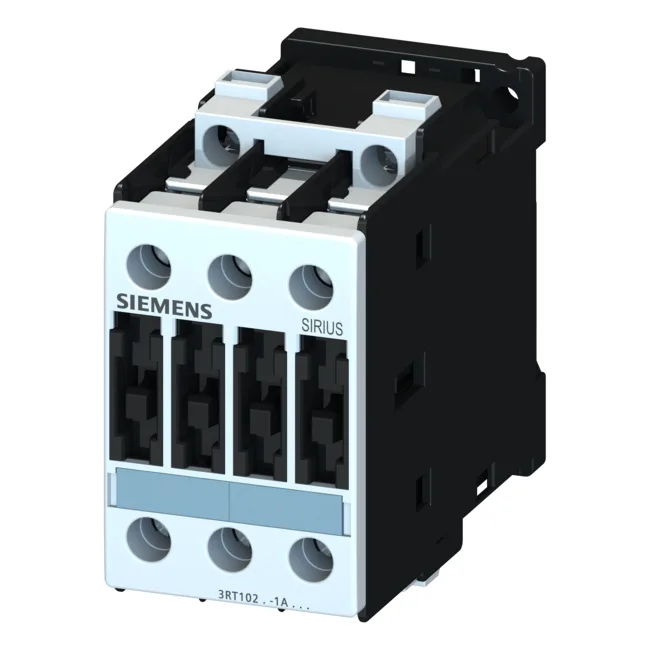
For reversing or inching duty (AC-4), the same contactor is rated 15.5 A at 400 V, which is a significantly lower power threshold than the AC-2 figure; if your application involves frequent plugging or jogging, the AC-4 current is the binding limit, not the AC-2 kW number. Short-circuit coordination is specified for Type 1 and Type 2: with Type 2 coordination (no damage to the contactor after a fault), use a gL/gG fuse rated 35 A; with Type 1 coordination (contactor may need replacement after a fault), the fuse can go up to 100 A. This lets a panel designer choose between protecting the contactor (Type 2) or allowing a higher fuse rating (Type 1) depending on the selectivity study. Auxiliary contact ratings span the common control voltages: 10 A at 24 V, 6 A at 230 V, 3 A at 400 V, and 0.3 A at 220 V DC. The DC ratings drop sharply with voltage — at 220 V DC the contact is only rated 0.3 A, so if you are switching a DC coil or solenoid at that voltage, verify the load current against that figure, not the AC rating. Mechanical endurance is listed at 10 million operations typical — this is the unloaded mechanical life; electrical life under load will be lower and depends on the switched current and duty cycle. For high-cycle applications (conveyor sortation, packaging machines), factor in a de-rate for the electrical endurance curve.
The 45 mm width (size S0) means it occupies a single 45 mm module on the rail — standard for this frame size. Side-by-side mounting is permitted with no spacing, which simplifies panel layout and keeps the rail fill factor tight. Main current circuit uses screw-type terminals accepting 2x (0.5 to 1.5 mm²), 2x (0.75 to 2.5 mm²), or max 2x (0.75 to 4 mm²) solid/stranded. For heavier feeds, the terminal also accepts 2x (1 to 2.5 mm²) and 2x (2.5 to 6 mm²) stranded, or max 2x 10 mm². AWG equivalents for main contacts: 2x (16 to 12), 2x (14 to 10), or 1x 8 AWG. Auxiliary and control circuit terminals accept 2x (20 to 16), 2x (18 to 14), or 1x 12 AWG. Strip length and torque values are on the nameplate — no special tooling beyond a standard screwdriver. Enclosure protection: IP20 on the front (finger-safe above the mounting surface), IP00 at the terminals (the connection points are not protected against accidental contact). In a typical enclosed panel this is fine — the panel door provides the outer IP rating. For exposed installations, a terminal cover or shrouding is needed.
Coil and control
Coil operates at 50 Hz (230 V rated) and 60 Hz (230 V rated), with an operating range of 0.8 to 1.1 times the rated voltage at 50 Hz and 0.85 to 1.1 at 60 Hz. This means at 50 Hz the coil will pick up and hold at 184 V (0.8 × 230 V) and must not exceed 253 V (1.1 × 230 V). At 60 Hz the pickup threshold is slightly higher at 195.5 V (0.85 × 230 V). The coil is designed for 50/60 Hz commonality, so it works on both supply frequencies without a change.