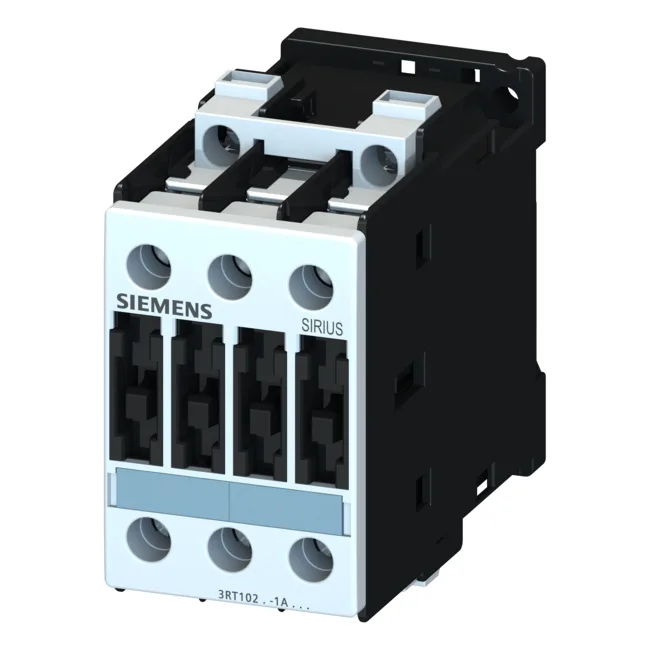
It is rated for motor switching at 11 kW on a 500 V or 690 V supply under AC-3 duty, and carries an AC-4 rating of 15.5 A at 400 V for reversing or inching applications.
The 11 kW rating at 500 V and 690 V AC-3 tells you this contactor handles standard squirrel-cage motor starting without welding the contacts — AC-3 covers starting and disconnecting a running motor. For resistive loads (AC-1), the maximum operating current is 10 A at 400 V. The mechanical endurance is 10 million operations, so the contactor outlasts most motor-driven machinery cycles. Short-circuit protection coordination is specified: type 2 coordination requires a gL/gG fuse rated 35 A, while type 1 coordination allows a 100 A gL/gG fuse. Type 2 means the contactor remains usable after a fault — no welding or damage — which matters for production lines where downtime for replacement is expensive.
Termination and wiring constraints
Main circuit terminals are screw-type, accepting solid conductors from 2x 0.5 mm² up to 2x 4 mm², or stranded conductors from 2x 1 mm² up to 2x 10 mm² (single conductor). AWG equivalents are 2x 16–12 solid or 2x 14–10 stranded, with a single 8 AWG maximum.
Environmental limits and mounting
Side-by-side mounting is permitted, with 6 mm clearance required at the side for heat dissipation. The contactor depth is 140 mm, height 85 mm, width 45 mm.