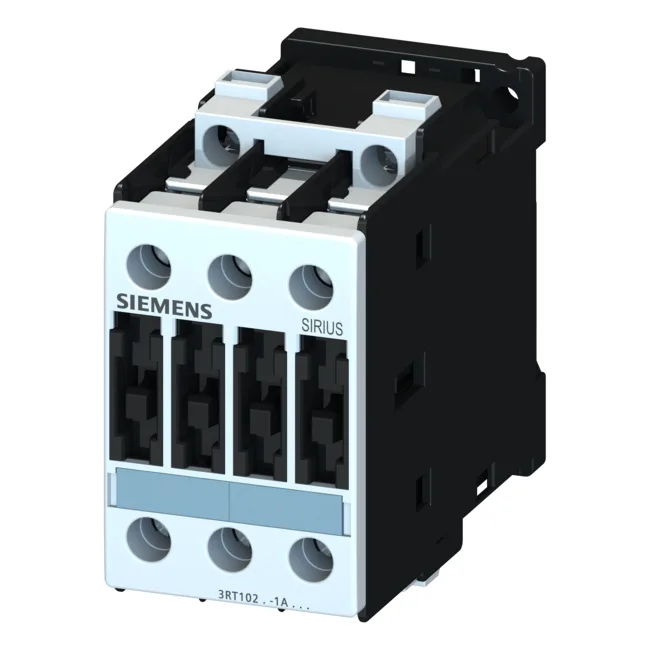
It handles 11 kW at 400 V in AC-2 (slip-ring motor start/run) and pulls 15.5 A in AC-4 (plugging/inching) at the same voltage — so it's sized for frequent reversing or jogging applications on a moderate motor load.
AC-4 at 400 V is 15.5 A, which covers the higher stress of reversing or inching duty; if your conveyor or hoist cycles through plugging, this is the number that governs contact life. For Type 2 coordination (no weld under fault), the upstream fuse must be gL/gG 35 A; for Type 1 (welding allowed, but no fire or shock), it's 100 A.
Terminals and wiring
Both main and auxiliary/control circuits use screw-type terminals. The main terminals accept solid wire from 2x (0.5 to 1.5 mm²) up to 2x (0.75 to 4 mm²), or stranded from 2x (1 to 2.5 mm²) up to 2x (2.5 to 6 mm²), with a max of 2x 10 mm². For AWG, that's 2x (16 to 12) solid or 2x (14 to 10) stranded, single 8 AWG max. The auxiliary contacts are smaller: 2x (20 to 16) AWG solid, 2x (18 to 14) stranded, single 12 AWG.
The substance prohibitance date of 01.07.2006 aligns with RoHS-style restrictions — the contactor is compliant with the EU's substance bans in effect from that date.