What it is and what it does
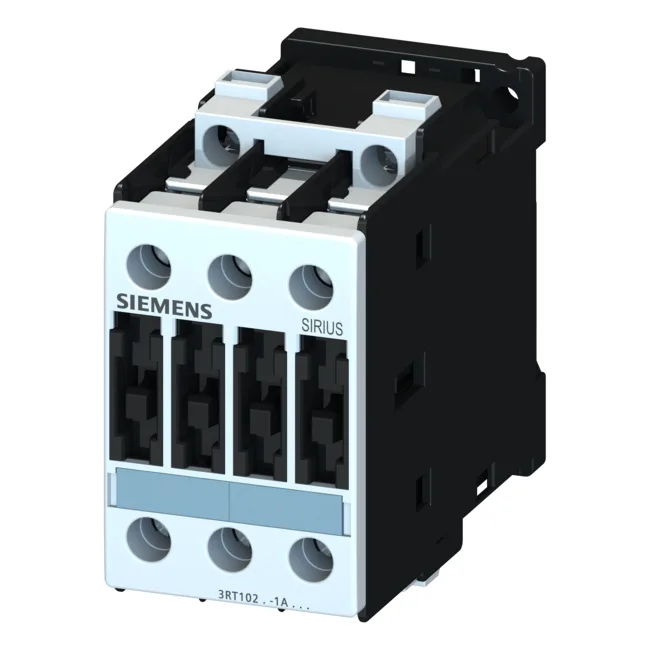
The Siemens 3RT1026-1AR60 is a SIRIUS power contactor in the S0 frame size, designed for switching motor loads in control panels. It mounts on a 35 mm DIN rail per EN 50022, with screw-type terminals for the main current circuit. Rated for AC-3 duty, it delivers 11 kW at both 500 V and 690 V, meaning it handles standard three-phase induction motors up to that power. For heavier-duty switching like slip-ring motors, the AC-2 rating at 400 V is also 11 kW. The AC-4 rating for reversing or inching duty is 15.5 A at 400 V — a lower continuous current than the AC-3 figure, so factor that in if your application cycles the contactor under load. The auxiliary contact block carries 10 A at 24 V DC and 6 A at 230 V AC, suitable for feeding PLC inputs or small control relays. Mechanical endurance is rated at 10 million operating cycles, which aligns with typical panel life for conveyor or pump control.
Panel fit and environment
The S0 footprint is 45 mm wide, 85 mm tall, and 91 mm deep — a compact three-pole block that leaves room for an overload relay alongside. Side-by-side mounting is allowed with 6 mm spacing to adjacent devices, which helps when packing multiple contactors on a DIN rail. Operating temperature range is -25 to +60 °C, and the pollution degree is rated 3 (conductive pollution expected, typical for industrial enclosures). Front protection is IP20; the terminals themselves are IP00, so the contactor needs to live inside a cabinet, not out in a washdown zone. Wire sizes for the main circuit accept solid conductors from 2x 0.5 mm² up to 2x 4 mm², or stranded up to 2x 10 mm². For AWG, that's 2x 16–12 or 1x 8. The auxiliary terminals take 2x 0.5–1.5 mm² solid or 2x 0.75–2.5 mm² stranded.
Coordination and protection
For Type 1 coordination (no damage to the contactor, but it may need replacement after a fault), the required upstream fuse is gL/gG 100 A. For Type 2 coordination (contactor remains usable after a fault), the fuse drops to gL/gG 35 A. This matters when you're specifying the short-circuit protection for the motor branch circuit. The contactor is rated for use at altitudes up to 2,000 m without derating. Coil operating range is 0.8–1.1 x Us at 50 Hz and 0.85–1.1 x Us at 60 Hz — standard tolerance for industrial control voltage.
