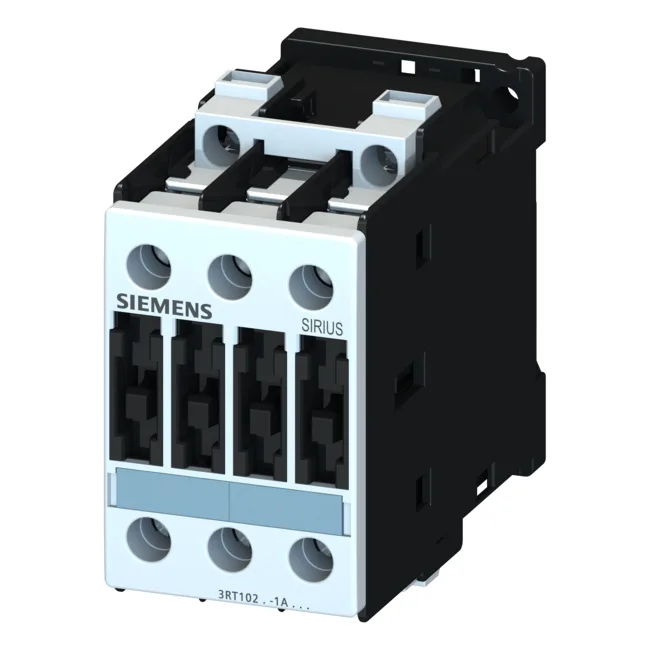
Contactor fit and ratings
Its AC-2 rating of 11 kW at 400 V covers wound-rotor motor duty — the kind you'd see on a conveyor or pump start — while the AC-4 rating of 15.5 A at 400 V handles plugging and inching cycles where the contactor opens under full load current. For resistive loads the AC-12 continuous current is 10 A, so it's not oversized for heater banks; the motor curve is where this part lives.
The 45 mm width means it occupies one standard module slot in a panel — useful when you're packing multiple contactors in a row. Side-by-side mounting is allowed, so no forced spacing gaps. For AWG, that's 2x 16-12 solid or 1x 8 stranded on the main contacts.
Type 1 coordination (contactor may need replacement after fault) allows a 100 A gL/gG fuse. That's a useful headroom range if you're coordinating with a motor starter or soft starter that has its own fuse spec. The coil draws 10 A at 24 V rated value, stepping down through the voltage range to 0.3 A at 220 V — standard for SIRIUS contactor coils.
Environmental limits
The front face carries IP20 protection — finger-safe when mounted in an enclosure, but the terminals themselves are IP00, so live parts are exposed if the contactor is not inside a panel.