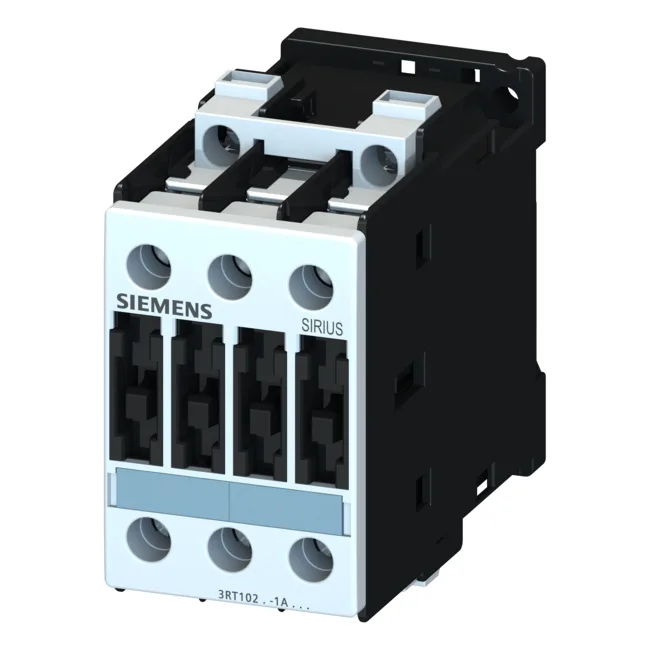
For AC-4 duty (plugging/reversing), it's rated at 15.5 A at 400 V — that's the cycle where the contactor takes the full locked-rotor current every time. The main circuit uses screw-type terminals, sized for 2x (0.5... 1.5 mm²), 2x (0.75... 2.5 mm²), max. 2x (0.75... 4 mm²) for solid conductors, and 2x (1... 2.5 mm²), 2x (2.5... 6 mm²), max. 2x 10 mm² for stranded. That's enough for the motor leads this contactor will typically see.
Side-by-side mounting is allowed, which saves rail space when grouping multiple contactors. Front protection is IP20 — safe from finger contact in a closed panel.
If your application cycles the contactor under full load, size on AC-4, not AC-2. Type 1 coordination requires a 100 A gL/gG fuse; Type 2 coordination needs a 35 A gL/gG fuse. Type 2 limits fault damage to the contactor — useful if you want to avoid replacing the contactor after a short circuit. Coil draw at 24 V is 10 A (inrush, likely), dropping to lower holding current — typical for a S0 contactor. The auxiliary contact ratings (at 60 V: 2 A; 110 V: 1 A; 220 V: 0.3 A) are for the control circuit, not the main power.