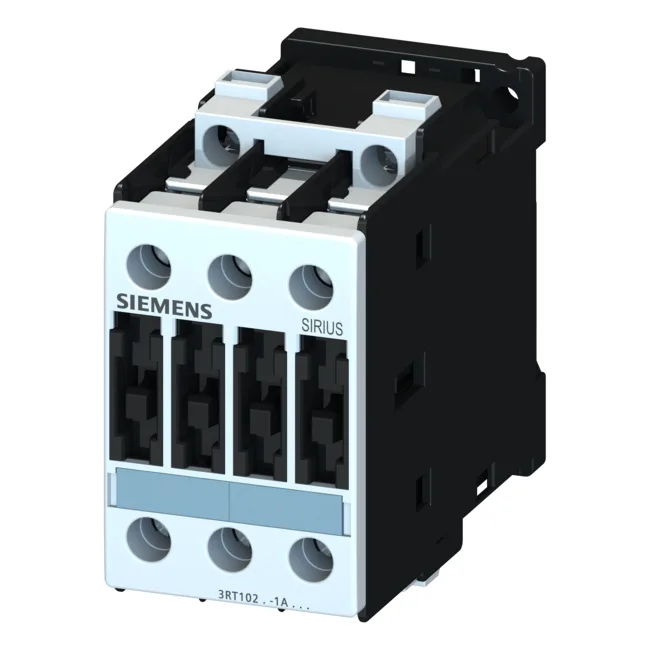
The 24 VDC coil draws 5.4 W on closing and holds at 5.4 W — a constant-power coil, so there's no inrush spike to factor into your 24 VDC supply budget. That holding power is the same as the closing power, which simplifies sizing the DC supply for a bank of contactors.
Motor switching capability across voltages
This contactor is rated for 11 kW at 400 V in AC-3 duty (squirrel-cage motor starting), and the same 11 kW at 690 V — so it handles the common European 400 V line and the higher 690 V industrial supply without derating the motor power. At 500 V it also carries 11 kW. For AC-4 duty (plugging/reversing/inching) at 400 V, the rated operating current is 15.5 A. These are the numbers that decide whether this contactor fits your motor nameplate. The auxiliary contact block handles switching at 24 VDC at 10 A, 60 VDC at 2 A, 110 VDC at 1 A, and 220 VDC at 0.3 A — so the DC break capacity drops sharply as voltage rises, which is typical for air-break contacts. If you're switching a DC control circuit above 60 V, verify the load current against these limits.
Mounting, wiring, and environment
Screw-type terminals for the main circuit accept 2x (1... 2.5 mm²) solid/stranded, 2x (2.5... 6 mm²), or max. 2x 10 mm². The control circuit (coil) terminals accept 2x (0.5... 1.5 mm²) solid, 2x (0.75... 2.5 mm²), or max. 2x (0.75... 4 mm²). Side-by-side mounting is allowed with a 6 mm gap at the side — no derating if you keep that clearance. Rated for operation from -25 °C to +60 °C, pollution degree 3 (industrial environment with conductive pollution), and altitude up to 2,000 m without derating.