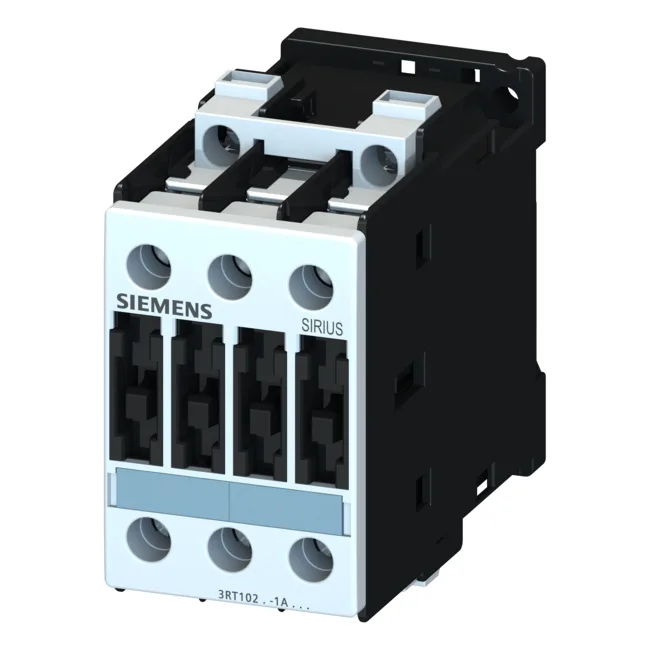
It carries a 24 VDC coil that pulls in at 5.4 W and holds at the same power — no AC hum, no rectifier needed, just a steady DC draw that's predictable for the PLC output driving it. Rated for AC-3 duty (motor start/run) at 11 kW on both 500 V and 690 V supplies, and 15.5 A in AC-4 (inching/plugging) at 400 V. For resistive or general-use circuits (AC-12), the maximum operating current is 10 A. The 45 mm width and 85 mm height fit standard S0 panel layouts. Side-by-side mounting is allowed with zero clearance — no derating required for adjacent contactors at rated load, though the 6 mm side clearance to grounded metal is the minimum to maintain.
Coordination and wiring reality
Screw-type terminals on the main circuit accept 2x (1 to 2.5 mm²) or 2x (2.5 to 6 mm²) stranded, max 2x 10 mm². AWG equivalents are 2x (16 to 12) and 2x (14 to 10), with a single 8 AWG max. The coil terminals take smaller wire: 2x (0.5 to 1.5 mm²) or 2x (0.75 to 2.5 mm²), max 2x (0.75 to 4 mm²). Strip and torque to the SIRIUS standard — no special tooling needed. Short-circuit protection depends on your coordination choice. This matters for selectivity studies on the panel's feeder breaker. Front protection is IP20 — safe for finger contact in an enclosed panel; the terminals themselves are IP00, so the panel door must be closed during operation.