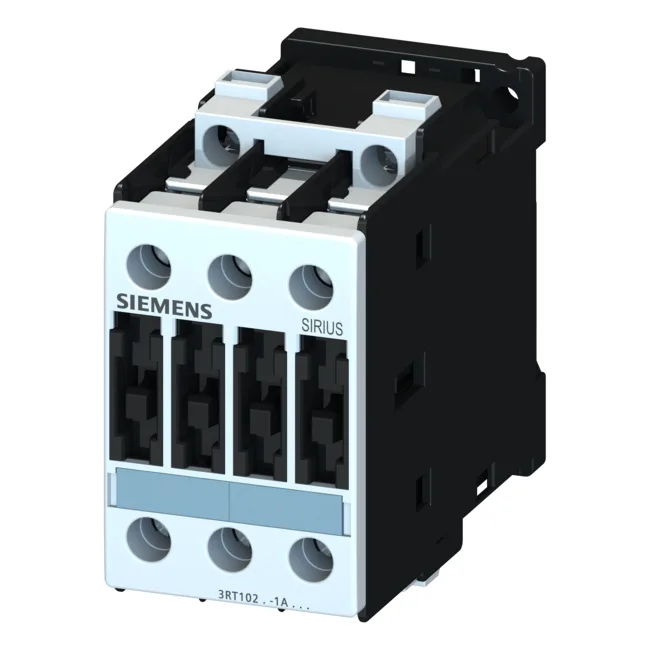
The 110 VDC coil pulls in at 5.4 W and holds at the same power, so the coil drive circuit needs to supply that continuously — no power-save circuit inside this model. Rated motor power hits 11 kW at 400 V in AC-2 duty (slip-ring motors, moderate overloads) and the same 11 kW at 500 V and 690 V, which covers most European-standard motor ratings up to that frame. General-use switching (AC-12) is rated at 10 A maximum, so it can handle resistive or lightly inductive control loads up to that current. The auxiliary contact block is configured as 0 instantaneous contacts — this is a main-pole-only contactor; add a separate auxiliary block if you need N/O or N/C feedback to the PLC.
Main circuit terminals are screw-type, accepting solid conductors from 2x 0.5 mm² up to max 2x 4 mm², and stranded from 2x 1 mm² up to max 2x 10 mm² (AWG equivalents: 2x 16-12 solid, 2x 14-10 stranded, 1x 8). Strip length and torque are standard for S0 screw terminals — no special tooling needed. Front face carries an IP20 rating — safe for finger-probe access in an enclosure. The terminal area itself is IP00, so the contactor must live inside a panel that provides the overall IP rating.
Short-circuit coordination and protection
Sizing the fuse to Type 2 keeps the contactor reusable after a fault — worth specifying if the panel is hard to access for replacement.
The auxiliary contact rating table covers DC switching at 24 V (10 A), 60 V (2 A), 110 V (1 A), and 220 V (0.3 A), plus AC at 230 V (6 A) and 400 V (3 A).