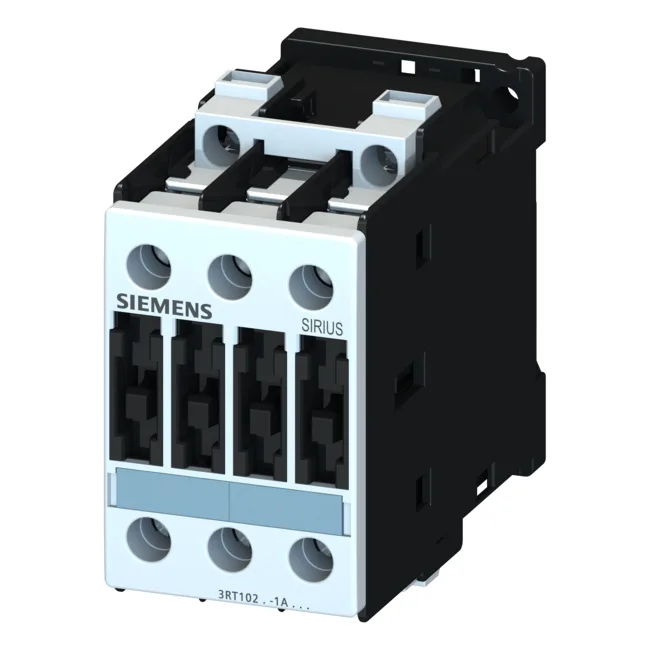
What it is and what it does
The Siemens 3RT1026-1BF40-1AA0 is a SIRIUS power contactor in size S0, designed for switching three-phase motors and resistive loads in control panels. It carries a 110 V DC coil, so the magnet holds in with 5.4 W holding power — no AC hum, no shading coil to fail. Rated for 11 kW at 690 V in AC-3 duty, and 11 kW at 400 V in AC-2 duty, it handles the common motor sizes in a 45 mm-wide package that snaps onto a 35 mm DIN rail per EN 50022.
What the ratings mean for fit
The AC-4 rating of 15.5 A at 400 V is the one that matters for reversing or inching duty — that's the contact wear curve. If you're plugging or jogging a motor, this is the number that governs contact life. The AC-2 rating of 11 kW at 400 V covers slip-ring motor starting; AC-3 (11 kW at 690 V) covers standard squirrel-cage starting. The 110 V DC coil pulls 5.4 W to close and 5.4 W to hold — no economizer circuit needed. Ambient range of -25 to +60 °C means it lives in a hot panel without derating, as long as the 6 mm side clearance is respected for heat rise.
Mounting and wiring
Screw-and-snap mounting onto 35 mm DIN rail. The S0 frame takes 45 mm of rail width. Main circuit terminals accept 2x (0.5 to 1.5 mm²) solid or 2x (0.75 to 2.5 mm²) stranded, up to max 2x (0.75 to 4 mm²) — or AWG equivalents 2x (16 to 12) solid, 2x (14 to 10) stranded, or 1x 8. The front face is IP20; the terminal area is IP00, so it expects enclosure protection for live parts. Pollution degree 3 means it's rated for industrial environments with conductive dust or condensation — standard for an uncoated panel contactor.
Coordination and protection
For Type 2 coordination (no damage to the contactor after a short circuit), the specified backup fuse is gL/gG 35 A. For Type 1 coordination (contactor may need replacement after a fault), a 100 A gL/gG fuse is permitted. This matters when you're designing a motor branch circuit that needs to coordinate with upstream breakers — the 35 A limit is the tighter constraint for panel design.
