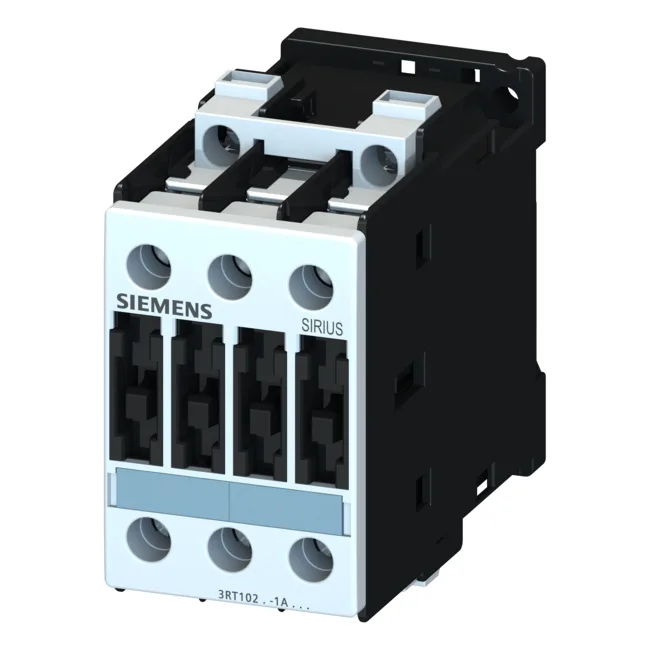
Its headline rating is 15.5 A in AC-4 duty at 400 V — that's the current it can interrupt during inching or plugging, where the contactor opens under full motor current. For standard AC-3 motor starting, it carries 11 kW at 400 V, which covers a 15 kW motor at 400 V three-phase. The integrated varistor surge suppressor clamps voltage spikes from the coil when de-energized — no external suppressor needed, which saves a wiring step and a DIN slot. The auxiliary contact block is rated 10 A at 24 V, 6 A at 230 V, and 3 A at 400 V, so it can switch PLC-level signals or small relay coils directly.
Coordination and fusing — type 1 vs type 2
For type 2 coordination (no contactor welding after a fault), Siemens specifies a gL/gG fuse of 35 A. For type 1 coordination (welding allowed, but no fire or shock hazard), the fuse can go up to 100 A. If you're designing to IEC 60947-4-1, type 2 is the standard for minimal downtime — the 35 A fuse limit means the upstream protection must be sized accordingly.
Terminal wiring and environment
Main circuit terminals accept screw-type connections: 2x (1–2.5 mm²) or 2x (2.5–6 mm²) stranded, up to 2x 10 mm² max. Auxiliary terminals handle 2x (0.5–1.5 mm²) or 2x (0.75–2.5 mm²).