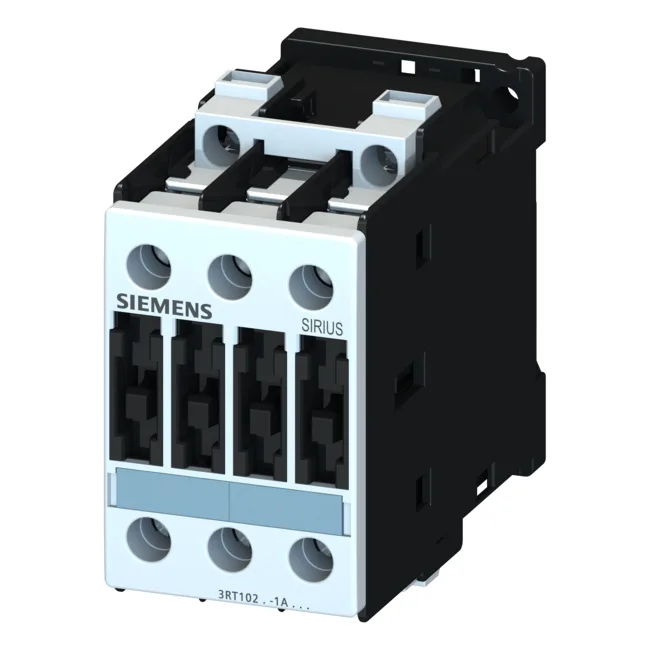
The AC motor ratings tell you what it can handle: 11 kW at both 500 V and 690 V, 50/60 Hz. That 11 kW at 690 V is the headline — it means this contactor handles a 690 V motor up to that power without derating for the higher voltage. For DC switching, the ratings drop with voltage: 10 A at 24 V, 2 A at 60 V, 1 A at 110 V, 0.3 A at 220 V, and 6 A at 230 V. The 230 V 6 A rating is notable — it covers common DC brake coils and control transformers in European panels. The AC-2 rating of 11 kW at 400 V covers slip-ring motor starting, where the contacts make and break at reduced current.
Termination and wiring — screw terminals, dual-wire capability
Main current circuit uses screw-type terminals accepting 2x (1 to 2.5 mm²), 2x (2.5 to 6 mm²), or up to 2x 10 mm² stranded. Solid wire range is 2x (0.25 to 2.5 mm²). AWG equivalents: 2x (16 to 12), 2x (14 to 10), or 1x 8 for the main contacts. The dual-wire capability means you can parallel two conductors per terminal — useful for daisy-chaining control power without extra terminal blocks.
Fault protection and coordination — what fuse to spec
That 35 A Type 2 limit is tight — if your upstream breaker is larger, you'll need to add a fuse or switch to a higher-rated contactor frame.
Environmental limits and IP ratings
Front of the contactor carries IP20 (finger-safe), while the terminal area is IP00 (open terminals) — keep the panel door interlocked or use terminal shrouds for live-work safety.