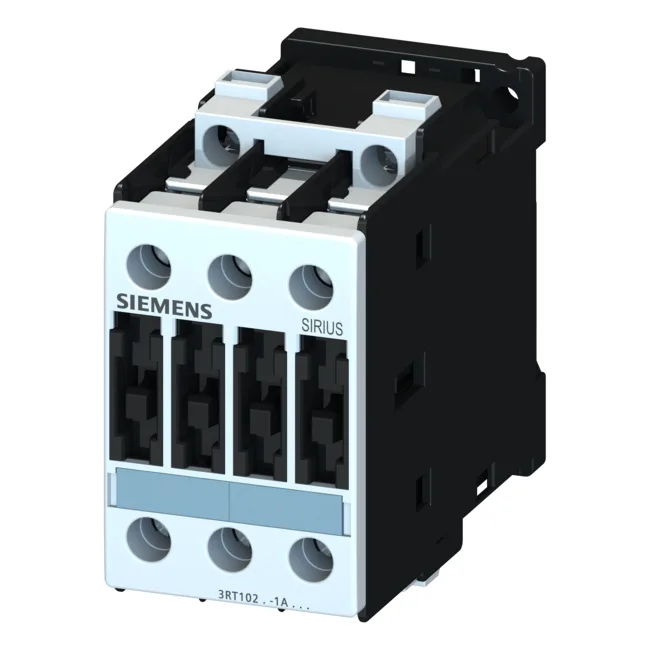
It carries 3 NO main contacts and is rated for 11 kW at both 500 V and 690 V, making it suitable for 400 V-class motors up to that power level in standard AC-3 duty. For demanding applications like reversing, inching, or plugging, the AC-4 rating of 15.5 A at 400 V defines the switching capability under high electrical stress — this is the figure to check when the load sees frequent starts or reversals under full current.
Main circuit connections use screw-type terminals accepting 2x (1 to 2.5 mm²) solid/stranded, 2x (2.5 to 6 mm²), or up to 2x 10 mm² — or AWG equivalents 2x (16 to 12), 2x (14 to 10), 1x 8.
For Type 2 coordination (contactor remains fully operational after a fault), the fuse must be limited to 35 A gL/gG. These values govern the upstream short-circuit protection device selection.
Auxiliary contacts and endurance
The integrated auxiliary contact block (1 NO + 0 NC) is rated for switching at various control voltages: 10 A at 24 V, 6 A at 230 V, 3 A at 400 V, and 2 A at 60 V, with lower ratings at 110 V (1 A) and 220 V (0.3 A). These cover typical PLC or relay interface signals.