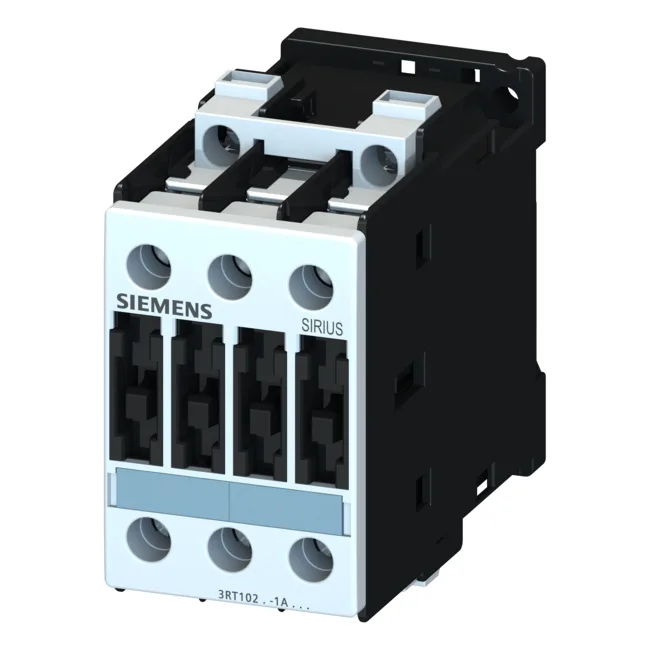
Rated at 11 kW at 400 V in AC-2 duty (slip-ring motor starting) and 15.5 A in AC-4 duty (plugging/inching), this contactor handles the heavy switching cycles found in crane, hoist, and conveyor applications where frequent reversals are the norm. The 3-pole main contact block carries three normally-open contacts with no normally-closed main poles.
The AC-4 rating of 15.5 A at 400 V is the one that governs real-world motor reversing duty — it's the current the contactor can interrupt reliably during inching or plugging, not just the steady-state AC-1 resistive load. For standard squirrel-cage motor starting (AC-3), the 11 kW at 400 V figure applies, but the datasheet's AC-2 and AC-4 values give you the headroom for demanding cycles. Auxiliary contact ratings are provided across the control voltage range: 10 A at 24 V, 6 A at 230 V, and 3 A at 400 V. These are the switching capacities for the built-in auxiliary contacts — useful for interlocking or PLC feedback without an add-on block. The contactor also carries ratings at 500 V and 690 V, each at 11 kW, indicating it can be used on 480 V or 600 V class systems with appropriate coordination.
Main current circuit connections use screw-type terminals accepting 2x (0.25 to 2.5 mm²) solid or 2x (1 to 2.5 mm²) stranded, up to 2x 10 mm² or 1x 8 AWG. The auxiliary circuit terminals accept 2x (0.25 to 2.5 mm²) solid. Strip length and torque values follow standard Siemens SIRIUS practice for the S0 frame. For short-circuit protection, type 2 coordination requires a gL/gG fuse rated 35 A, while type 1 coordination allows up to 100 A. This lets you balance protection level with fuse size depending on whether you need the contactor to remain serviceable after a fault.
Dimensions are 65 mm wide, 85 mm high, and 91 mm deep — the standard S0 footprint.