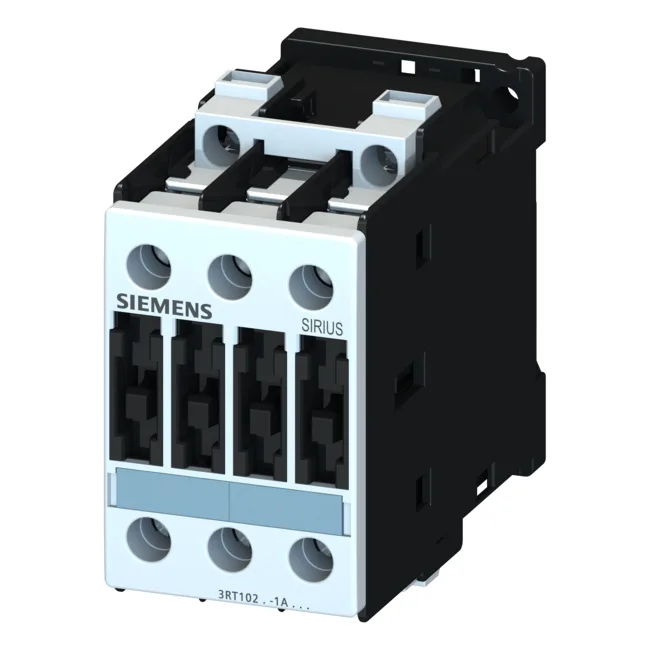
At 45 mm wide and 85 mm tall, it occupies a single module width on the rail, leaving space alongside for overload relays and auxiliary contact blocks.
The headline AC-3 rating of 11 kW at 400 V means this contactor is sized for a motor drawing roughly 22 A under full load at that voltage — the AC-3 duty class covers starting and plugging, where the contactor closes on inrush and breaks the running current. For the more demanding AC-4 duty (inching, reversing, plugging with full load), the rated operating current drops to 15.5 A at 400 V, so if your application requires frequent reversing or jogging, you need to stay within that lower current envelope. For resistive loads (AC-12), the maximum operating current is 10 A. The auxiliary contact ratings span from 10 A at 24 V down to 0.3 A at 220 V, covering typical PLC and relay control circuits. With Type 1 coordination (contactor may need replacement after a fault), the fuse can be 100 A. This lets you balance protection level against fuse size in the panel design.
Mounting, Wiring, and Environmental Fit
The contactor accepts screw-type terminals for the main current circuit, with wire ranges from 2x (0.25 to 2.5 mm²) solid up to 2x 10 mm² stranded, or 2x (16 to 12 AWG) solid. Finely stranded wire with ferrule is handled at 2x (0.25 to 1.5 mm²). Strip length and torque values follow standard Siemens SIRIUS practice for the S0 frame. The front face carries an IP20 rating, meaning finger-safe touch protection once wired — standard for inside a locked panel. The terminal area itself is rated IP00, so live parts are exposed during installation; normal practice is to de-energize before working on the terminals.
For high-cycle applications (frequent starts per hour), factor the electrical life derating from the Siemens SIRIUS application manual.