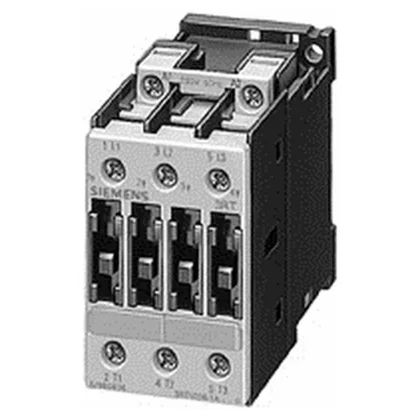
The 3RT1026-3AP60: The AC-4 rating of 15.5 A at 400 V tells you this contactor handles reversing or inching duty — plugging, jogging, frequent starts — where the motor draws locked-rotor current each time. For standard AC-2 or AC-3 starting (slip-ring or squirrel-cage motors), it's rated 11 kW at 400 V. That's the number to match against your motor nameplate for continuous running. The auxiliary contact block carries 10 A at 24 V, 6 A at 230 V, and 3 A at 400 V — enough for a PLC input or a holding circuit, but watch the voltage drop on long runs.
Coordination and short-circuit protection
This matters when you're laying out the MCC bucket — the fuse size determines the upstream breaker selectivity. Pollution degree 3 (industrial, conductive dust) and IP20 on the front, IP00 at the terminals mean it's meant for an enclosed panel, not open mounting.
Operating conditions and wiring
Rated for -25 to +60 °C ambient during operation, with a maximum operating altitude of 2 000 m. The screw terminals accept 2 x (0.25 to 2.5 mm²) solid or stranded, or up to 2 x 10 mm² for the main circuit — standard for panel wiring with ferrule or direct.