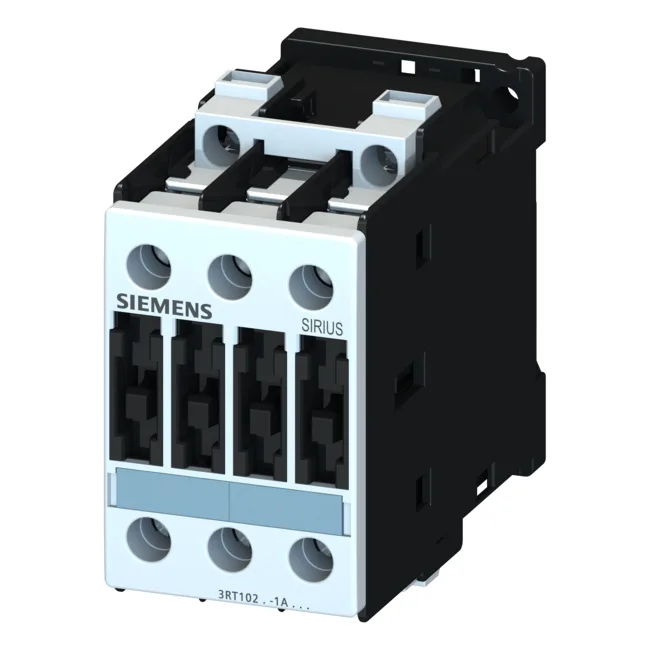
It carries an AC-2 rating of 11 kW at 400 V, meaning it handles wound-rotor motors and slip-ring applications at that power level. For AC-4 duty — plugging and inching of squirrel-cage motors — it's rated 15.5 A at 400 V. A built-in varistor provides surge suppression across the coil, which saves panel space and simplifies wiring — no separate suppressor module to mount and connect.
The S0 frame footprint is 45 mm wide, 119 mm tall, and 100 mm deep — a compact envelope that fits standard distribution boards and motor control centers. Front face carries IP20 protection — safe from finger contact during panel access. The terminal area itself is IP00, so live parts are exposed when the terminals are open; standard panel guarding applies.
Main circuit connections use screw-type terminals accepting 2x (0.25...2.5 mm²) solid, 2x (1...2.5 mm²) stranded, 2x (2.5...6 mm²) stranded, or max 2x 10 mm². AWG equivalents are 2x (16...12), 2x (14...10), and 1x 8. This range covers typical motor feeder cables up to 6 mm² and allows paralleling two conductors per terminal for daisy-chaining. For Type 2 coordination (contactor remains operational after clearing the fault), the fuse drops to 35 A gL/gG. The 35 A limit is the one to design by if you want to avoid swapping contactors after a fault.
Environmental and endurance ratings
Mechanical endurance is 10 million operations — the contactor's mechanical life before wear-out.