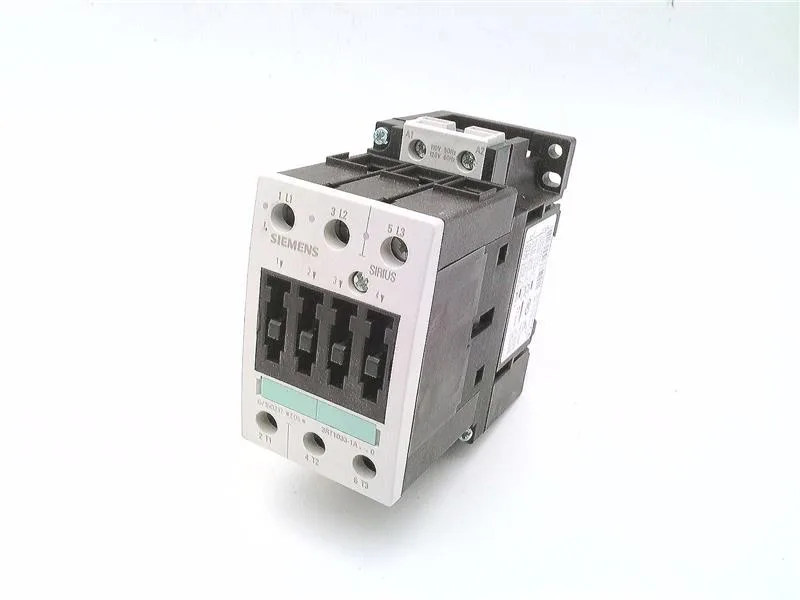
It carries a 15 kW rating in AC-2 duty at 400 V, 11 kW at 500 V, and 9.5 kW at 690 V — so it handles wound-rotor motors and slip-ring applications where the current doesn't drop to zero at each opening. The coil is 110 V at 50 Hz / 120 V at 60 Hz, with an operating range of 0.8 to 1.1 times rated voltage at both frequencies. That means the coil holds in reliably even if the control supply sags a bit.
AC-4 (plugging, inching) drops to 250 per hour — the contactor can handle the severe duty, but the switching rate is limited. Auxiliary contacts are rated 10 A at 24 V, 6 A at 230 V, and 3 A at 400 V — enough for pilot duty on PLC inputs or small relay coils. The main circuit uses screw-type terminals accepting stranded wire up to 25 mm² or solid/stranded 2x 0.75 to 16 mm². Auxiliary terminals accept solid wire 2x 0.5 to 1.5 mm² or 2x 0.75 to 2.5 mm² (max 4 mm²). Strip length and torque specs are in the datasheet, but the terminal design is standard for panel wiring.
The contactor measures 55 mm wide, 112 mm high, and 115 mm deep — it fits a standard 55 mm-wide DIN-rail slot. The screw terminals face forward, so wiring is accessible with the contactor snapped onto the rail. For a panel in a non-conditioned space (pump house, roof, warehouse), the -25 °C lower limit is fine for most climates. The IP20 front means you can touch the enclosure without a shock risk, but the IP00 terminals need a cover or panel door for safety.