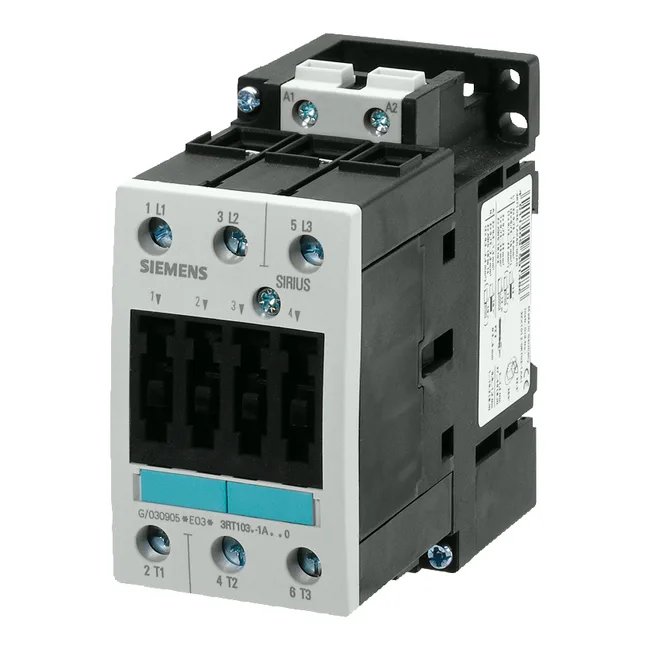
What this SIRIUS size S2 contactor does in a panel
The screw-type terminals on the main current circuit accept solid wire from 0.25 to 2.5 mm² and stranded from 0.75 to 25 mm² — enough range to land a 16 mm² motor feeder without lugging down. The 24 VAC 50/60 Hz coil pulls the contactor in across a 0.8 to 1.1 times rated voltage window at 50 Hz, and 0.85 to 1.1 at 60 Hz. That means it holds in during a sag down to about 19 V at 50 Hz, but drops out reliably below that — useful for brownout ride-through in a line that sees voltage dips. Rated for motor duty at 11 kW at 500 V and 9.5 kW at 690 V, this contactor handles the full-load current of a 15 HP 460 V motor or a 12.5 HP 600 V motor in AC-3 service. The switching frequency tops out at 1 000 operations per hour in AC-3, so it keeps up with a cycling conveyor or pump start-stop sequence without overheating the coil or arc chamber.
Switching capacity — what the voltage-current pairs tell you
The contactor's rated operational current varies by voltage and duty. At 24 V it switches 10 A; at 230 V it switches 6 A; at 400 V it switches 3 A. These are the thermal current ratings for the main contacts in AC-1 service — resistive loads like heaters or lighting banks. For motor loads (AC-3), the power ratings at 500 V (11 kW) and 690 V (9.5 kW) are the numbers that govern the real-world fit. The arc-extinguishing system clears a fault in 10 to 15 ms arcing time, with a DC dropout delay of 20 to 30 ms. That's fast enough to keep downstream overload relays from nuisance-tripping on a contactor weld, but slow enough to avoid inductive kickback issues on the coil suppression circuit.
The IP20 front face and IP00 terminal area mean it's panel-protected — the enclosure provides the washdown or dust seal, not the contactor itself.
Panel integration — DIN rail, side-by-side, and derating
The screw terminals accept two conductors per clamp, so daisy-chaining a control circuit or paralleling a heater load is straightforward without extra terminal blocks.