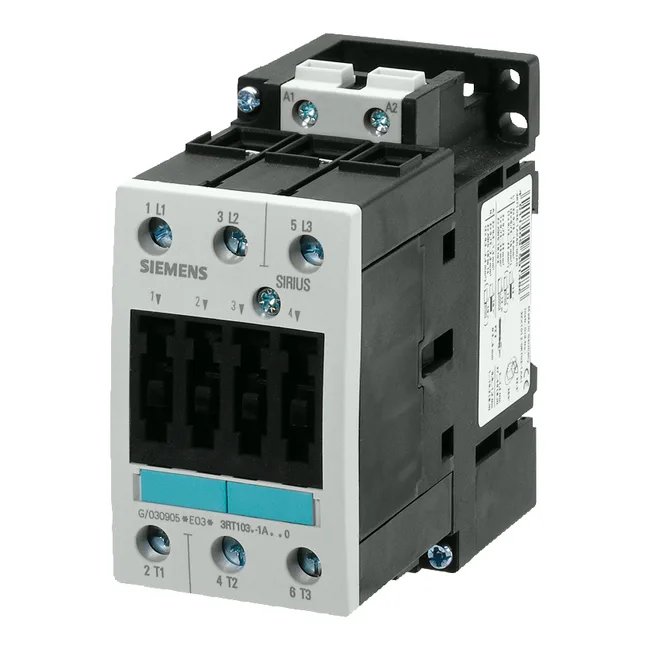
Its headline rating is 18.5 kW at 500 V under AC-3 duty (cites:) — that's the motor-switching current it handles for standard squirrel-cage motors, so it's the number you check against your motor nameplate. The contactor also carries a 10 kW rating at 690 V AC-3 (cites:), useful if you're running a higher-voltage motor on a 690 V line. For resistive loads (AC-1) at 400 V, it's rated 31 kW (cites:). The contactor is 55 mm wide, 112 mm tall, and 115 mm deep (cites:,) — that 115 mm depth is the dimension you check for enclosure clearance, especially if you're fitting it behind a shallow panel door.
For solid conductors, it accepts 2x (0.5 to 1.5 mm²), 2x (0.75 to 2.5 mm²), or max 2x (0.75 to 4 mm²) (cites:). For stranded wire, it takes 2x (0.75 to 25 mm²) (cites:) — that's a generous range, so you can land a 25 mm² motor feed without a ferrule if the lug is crimped right. Side-by-side mounting is allowed (cites:), with 6 mm spacing at the side (cites:).
Coil and auxiliary ratings
The coil is rated 24 V at 50/60 Hz (cites:,). The contactor's auxiliary contact ratings cover a range of voltages: 10 A at 24 V, 2 A at 60 V, 1 A at 110 V, 6 A at 230 V, 3 A at 400 V (cites:,). The switching frequency at AC-3 is rated at 1,000 operations per hour maximum (cites:) — that's about one cycle every 3.6 seconds, so fine for most conveyor or pump cycling but not for high-speed pick-and-place.
The contactor is identified per DIN EN 61346-2 and DIN EN 81346-2 with function code Q (cites:,). The IP rating on the front is IP00 (cites:) — that's an open device, so it needs to live inside a panel or enclosure, not out in the washdown zone. Side-by-side mounting is permitted (cites:), which helps when you're packing multiple contactors on a DIN rail.