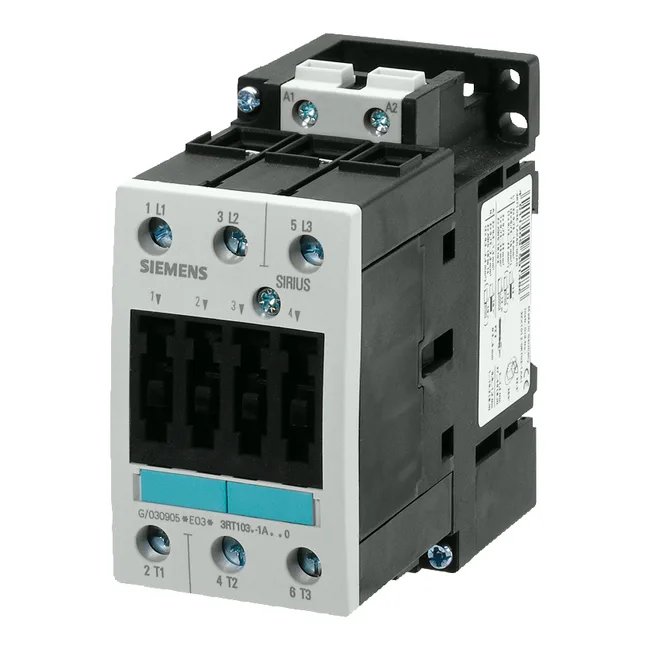
The Siemens SIRIUS 3RT1034-1AG64 is a size S2 power contactor rated for motor switching up to 18.5 kW at 500 V in AC-3 duty, and 15 kW at 400 V in AC-2 duty — covering the heavy lifting for pumps, fans, and compressors in a standard 400 V three-phase panel.
The 18.5 kW at 500 V AC-3 rating is the motor-switching figure that determines fit for a 3-phase induction motor on a 480 V line. The 15 kW at 400 V AC-2 rating covers lower-duty applications like slip-ring motors or frequent jogging. For resistive loads (AC-1), the contactor can cycle up to 1200 operations per hour; for the heaviest AC-4 plugging/reversing duty, it's rated at 250 ops/h. The coil accepts 100 V at 50 Hz and 100–110 V at 60 Hz, with a pick-up range of 0.8–1.1x rated voltage at 50 Hz and 0.85–1.1x at 60 Hz. Auxiliary contact ratings: 10 A at 24 V, 6 A at 230 V, 3 A at 400 V, and 0.3 A at 220 V DC — enough for PLC-level signal switching or small relay coils.
The screw terminals accept ferruled stranded wire up to 25 mm² — no special crimp tool needed beyond a standard hex die. For side-by-side mounting, no gap is required, so you can pack multiple contactors across a DIN rail without losing density.