What it is and what it does
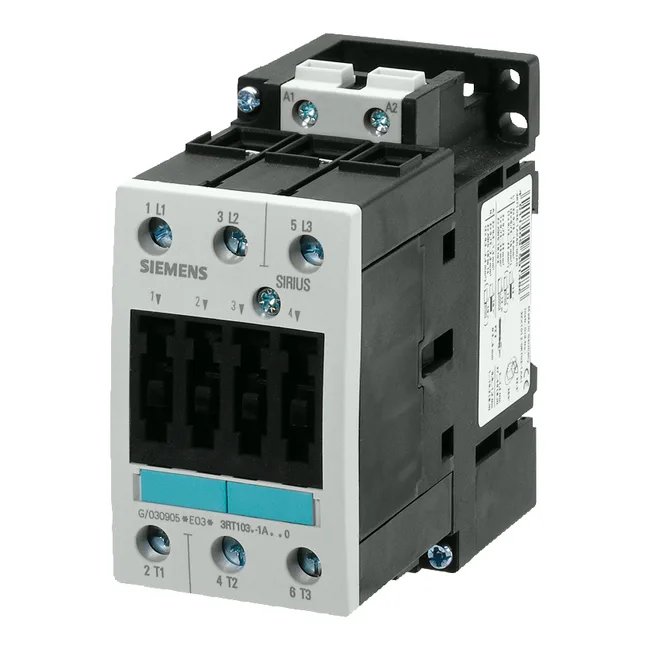
The Siemens 3RT1034-1AH00 is a SIRIUS power contactor in the S2 frame size, built for switching motor loads in industrial control panels. It's a screw-type terminal unit rated for AC-2 duty at 15 kW on a 400 V line — that's the standard for slip-ring motors or wound-rotor applications where you need controlled starting torque, not just on-off. The 55 mm width and 112 mm height let it pack into a standard 35 mm DIN rail enclosure per EN 50022, with side-by-side mounting allowed when you're stacking multiple contactors in a row.
Key ratings and what they mean for your panel
The headline number here is the AC-2 rating: 15 kW at 400 V. That's the motor-switching current you design around, not the AC-1 resistive load. For AC-4 duty — plugging or inching — it handles 29 A at 400 V, which is a tougher thermal cycle. The mechanical life is typical at 10 million operations, but the switching frequency tells the real story: 1 200 cycles per hour on AC-1, 1 000 on AC-3, and only 250 on AC-4. If you're jogging a conveyor drive all shift, that AC-4 limit is the one that governs contactor life, not the mechanical number. Temperature range is -25 to +60 °C during operation, with storage from -55 to +80 °C. Pollution degree 3 means it's rated for the conductive dust and humidity you'd find in a typical factory floor panel — not a clean room, not a sealed cabinet. The front face carries IP20 finger protection; the terminal area is IP00, so keep your hands clear when it's live.
Wiring it up
Main circuit terminals accept solid wire up to 2x 4 mm² or stranded up to 2x 25 mm². For the coil and aux circuits, you've got solid options from 0.5 to 4 mm². That's enough for standard motor leads up to the 16 mm² minimum at 40 °C ambient. The screw terminals are straightforward for panel builders — no special tooling, just a good Pozidriv bit and the right torque. At 115 mm depth, it fits in a 200 mm deep enclosure with room for wiring ducts.
