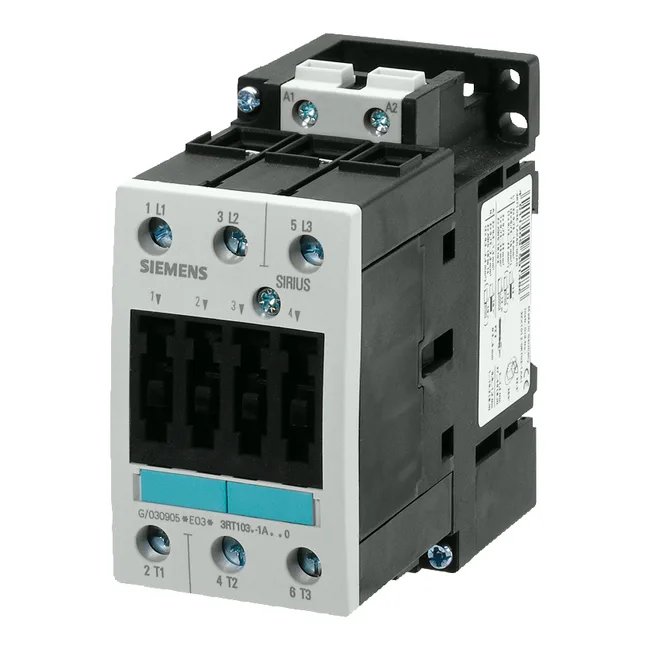
It handles 18.5 kW at 500 V in AC-3 duty (motor switching) and 10 kW at 690 V, with a mechanical life of 10,000,000 operations. Rated for 50/60 Hz, the contactor carries a 230 V coil at both frequencies and delivers 10 A at 24 V rated value for auxiliary circuits. The IP20 front enclosure protects against finger contact, while the terminal area is IP00 — expect exposed live parts at the wiring point, standard for this class.
Screw-type terminals on the main current circuit accept solid conductors from 2x (0.5 to 1.5 mm²) up to 2x (0.75 to 4 mm²) for the smaller wires, and stranded up to 2x (0.75 to 25 mm²). The solid-or-stranded range covers 2x (0.75 to 16 mm²). That covers most panel wiring from control circuits to motor feeders without needing adapters.
Maximum operating rates: 1,200 cycles per hour for AC-1 (resistive loads), 1,000 for AC-3 (motor starting), 750 for AC-2 (slip-ring motors), and 250 for AC-4 (plugging/inching). The 50 Hz operating range of 0.8 to 1.1 and 60 Hz range of 0.85 to 1.1 define the voltage tolerance band for the coil. Auxiliary contact ratings: 10 A at 24 V, 6 A at 230 V, 3 A at 400 V, and 2 A at 60 V. The 220 V rated value is 0.3 A, and 110 V is 1 A. These numbers govern what pilot devices or PLC inputs the auxiliary contacts can drive — stay within these limits to avoid contact welding.