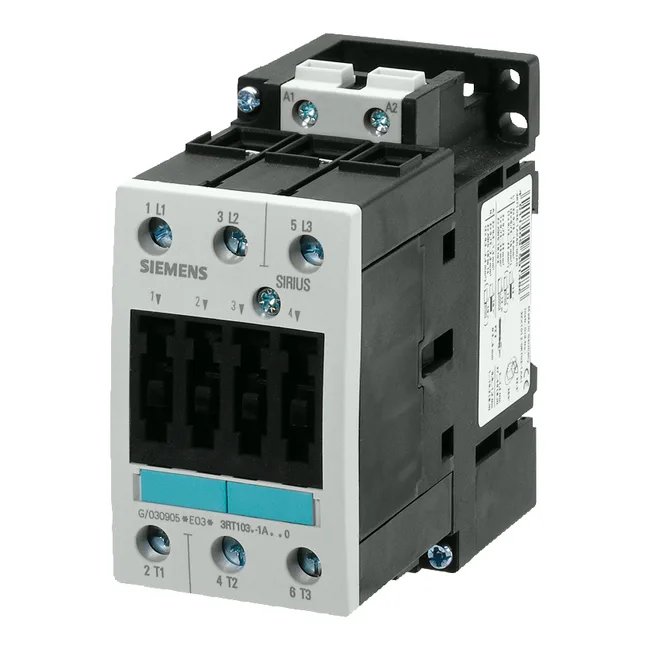
The Siemens SIRIUS 3RT1034-1AQ20 is a size S2 power contactor rated for switching motor loads up to 18.5 kW at 500 V under AC-3 duty (standard squirrel-cage motors), and 15 kW at 400 V under AC-2 duty (slip-ring motors or moderate starting). It handles 10 kW at 690 V, so it can serve 690 V delta-connected motors in European or marine panels.
The AC-2 rating of 15 kW at 400 V is for more demanding applications like wound-rotor motors or frequent jogging, where the contacts make and break under load more often. Electrical life depends on the switching category and load current — the datasheet derating curves apply, but for typical AC-3 motor switching at rated current you can expect hundreds of thousands of operations before contact wear becomes a concern. The auxiliary contact block (integrated or add-on) is rated at 10 A at 24 V, 6 A at 230 V, and 3 A at 400 V — enough for PLC inputs, pilot lights, or interlocking relays in the control circuit. The front of the contactor is IP20 (finger-safe), while the terminal area is IP00 — meaning the power connections are exposed and need to be inside an enclosure or guarded by the panel door.
Wiring and Integration Notes
The auxiliary contacts use smaller screw terminals. Use ferruled stranded wire for reliable connections in high-vibration environments like conveyor lines or compressor skids. Coil operates on 50 or 60 Hz with a voltage tolerance of 0.8 to 1.1 times rated at 50 Hz, and 0.85 to 1.1 at 60 Hz. Pick-up time is 7 to 20 ms, arcing time 10 to 15 ms — fast enough for most sequencing but worth noting if you have very tight timing requirements in a safety circuit. That's a standard size S2 footprint — it fits alongside other SIRIUS components in a pre-drilled panel layout. Side-by-side mounting means no spacing required between units, so you can pack multiple contactors into a 600 mm wide enclosure.
Sourcing and Cross-Reference Reality
This is an active, current-production part. For new designs or spares, it's a straightforward order through Siemens distribution. No last-time-buy or obsolescence concerns. If you're looking at a panel originally specified with a 3RT1036-1AB00 (a larger size S3 contactor), the 3RT1034-1AQ20 will not drop in without rewiring — the S2 has a different footprint and lower current ratings. The 3RT1034-1AQ20 is the correct size for motor loads up to 18.5 kW at 500 V; step up to the S3 frame for higher currents or larger motors.