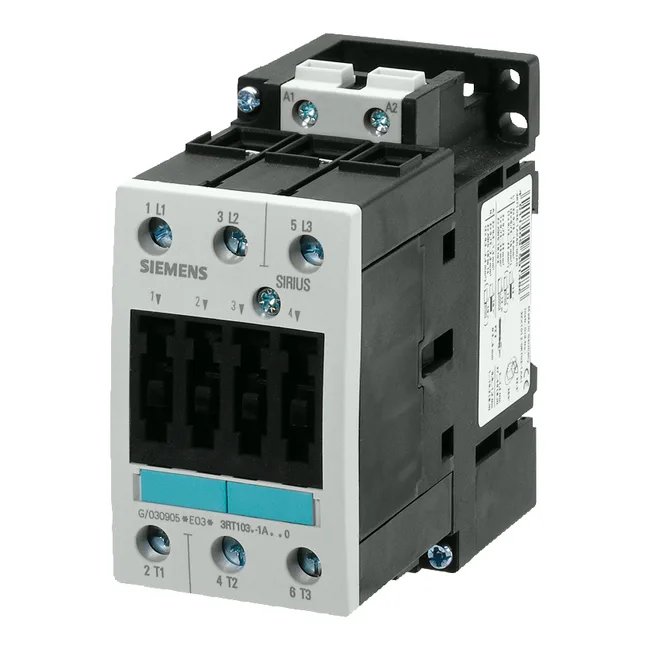
What this contactor is and where it fits
The Siemens SIRIUS 3RT1034-1AR60 is a size S2 power contactor rated for AC-2 duty at 15 kW on a 400 V, 50 Hz supply — that's the motor-switching curve for slip-ring rotors or wound-rotor motors where the load current stays high through the start. On 60 Hz it handles 400 to 440 V. The front face carries an IP20 rating (safe against finger contact), but the terminal area is IP00 — so panel builders need to keep live parts behind a door or cover. It mounts via screw or snap-on onto a 35 mm DIN rail per EN 50022, and side-by-side mounting is allowed, which saves rail space in a multi-contactor group.
Terminal wiring and connection
Main current circuit terminals are screw-type, accepting solid conductors from 0.5 to 4 mm² (two per clamp) and stranded up to 25 mm². That's a wide enough range to land a 4 mm² motor feed on the line side and still double up a 1.5 mm² control wire on the same terminal. The auxiliary circuit uses the same screw clamps. Strip length and torque aren't listed here, but the 0.5 mm² minimum means fine-stranded thermocouple or signal wire needs a ferrule to avoid whiskers under the screw.
Switching performance and thermal limits
Mechanical life is 10 million operations typical. Electrical life depends on the duty cycle: AC-1 (resistive) allows 1,200 operations per hour, AC-3 (standard squirrel-cage motor start/run) allows 1,000 ops/h, and AC-4 (plugging/inching) drops to 250 ops/h. The arcing time is 10 to 15 ms, and the operate/release time across the coil is 7 to 20 ms at AC — fast enough for most motor control but not for precision synchronizing. Ambient operating range is -25 to +60 °C, storage from -55 to +80 °C. Pollution degree 3 means it's suited for industrial environments with conductive dust or occasional condensation — no extra conformal coating needed for a typical panel.
