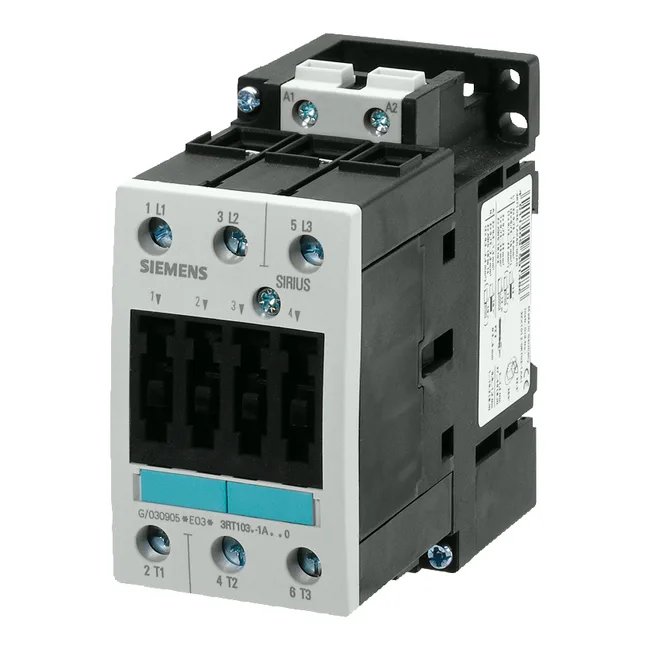
Rated for AC-3 motor starting at 18.5 kW at 500 V and 10 kW at 690 V, this contactor handles the high inrush of induction motors. The auxiliary contact block is rated 10 A at 24 V, 2 A at 60 V, 1 A at 110 V, 0.3 A at 220 V, 6 A at 230 V, and 3 A at 400 V — covering typical PLC-level signals and small control loads. Mechanical life is rated at 10 million operations, with switching rates up to 1200 cycles per hour for resistive loads (AC-1), 1000 for AC-3 motor duty, and 250 for AC-4 reversing duty.
The S2 frame occupies 55 mm width, 112 mm height, and 130 mm depth — fits standard 200 mm deep enclosures with room for wiring. Side-by-side mounting is permitted, so multiple contactors can be ganged without spacing gaps — useful for compact motor control centers.
Main circuit terminals accept solid conductors: 2x (0.5...1.5 mm²), 2x (0.75...2.5 mm²), max 2x (0.75...4 mm²). Stranded: 2x (0.75...25 mm²). For mixed solid/stranded: 2x (0.75...16 mm²). At 40 °C, minimum permissible is 16 mm² for the main circuit. Coil drop-out time is 20 to 30 ms DC, arcing time 10 to 15 ms — relevant for timing interlock circuits where contactor overlap must be minimized.
RoHS compliance date is 05/01/2012, confirming it meets the EU Restriction of Hazardous Substances directive for the current revision.