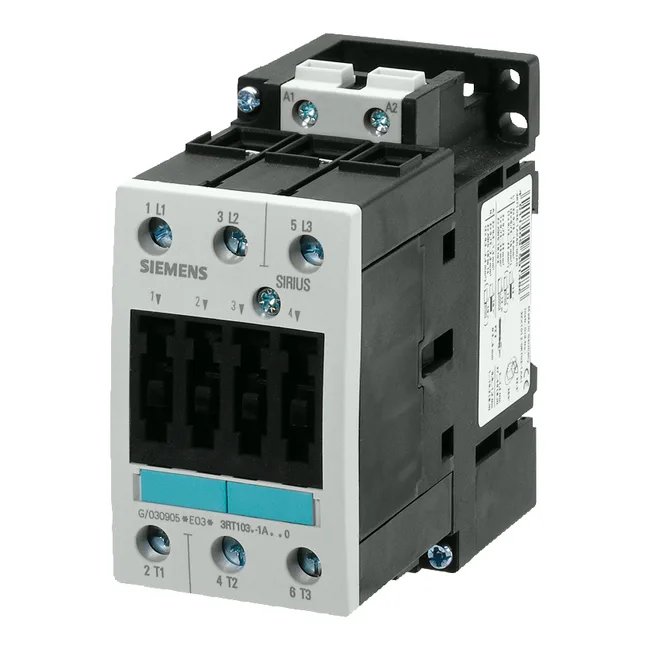
For heavier switching like inching or plugging (AC-4), the maximum rate drops to 250 1/h — plan the cycle count if your application includes frequent reversing or jogging. Solid wire acceptance covers 2x (0.5... 1.5 mm²) and 2x (0.75... 2.5 mm²), up to max 2x (0.75... 4 mm²). That range covers most panel wiring from control-circuit tails to motor feeders without needing adapters.
That's the inrush to latch the armature; once sealed, the holding current is lower. The auxiliary contact ratings span multiple voltages: 10 A at 24 V, 6 A at 230 V, 3 A at 400 V, and 0.3 A at 220 V DC. The 400 V AC rating of 3 A is typical for signaling back to a 400 V control circuit; the 220 V DC rating of 0.3 A is the limit for DC switching — inductive DC loads will need a diode or RC snubber across the load. Motor power ratings: 18.5 kW at 500 V (AC-3), 15 kW at 400 V (AC-2), and 10 kW at 690 V. For AC-4 at 400 V, the contactor is rated at 29 A. If you're switching a motor above 18.5 kW at 500 V, you need a larger frame (size S3 or S6).
The contactor measures 55 mm wide, 112 mm high, and 130 mm deep — that's the S2 footprint. The IP20 front enclosure means it's protected against fingers and solid objects larger than 12 mm; the terminals themselves are IP00, so the panel enclosure must provide the overall IP rating.