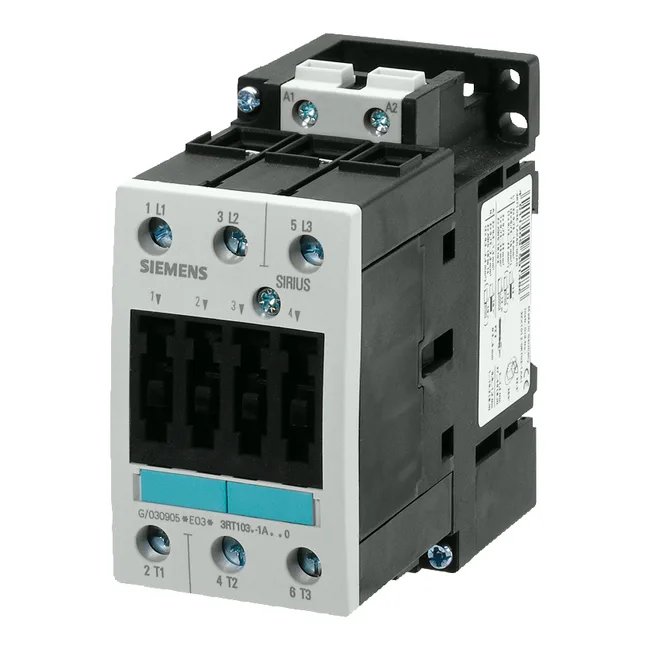
The Siemens 3RT1034-1BE44 is a SIRIUS power contactor in the S2 frame size, rated 18.5 kW at 500 V AC-3 and 10 kW at 690 V AC-3 — so it handles motor loads up to those power levels in standard three-phase induction motor duty. At AC-4 (plugging/reversing) it carries 29 A at 400 V, which is the rating that governs severe switching applications like crane hoists or reversing conveyors. It snaps onto a 35 mm DIN rail per EN 50022 and measures 55 mm wide by 112 mm high by 179 mm deep — a compact footprint that leaves room for auxiliary contact blocks or overload relays in a crowded panel.
For heavier duty like slip-ring motors or frequent jogging, the AC-2 rating of 15 kW at 400 V applies, and for reversing or inching, the AC-4 rating of 29 A at 400 V is the limiting factor.
Main power circuit uses screw-type terminals. Solid wire accepts 2x 0.5–1.5 mm², 2x 0.75–2.5 mm², or max 2x 0.75–4 mm². Stranded wire accepts 2x 0.75–25 mm². The panel door or cover must provide the final touch protection. Coil data: at 24 V DC the contactor draws 10 A inrush (likely the pick-up current), and at 60 V DC it draws 2 A.