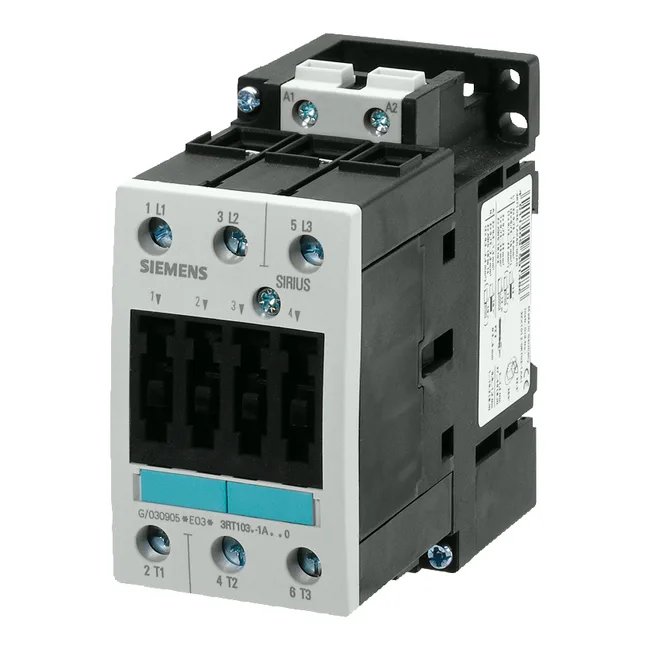
Rated for AC-3 duty at 500 V, it delivers 18.5 kW — the rating that governs motor switching for pumps, fans, and compressors. At 690 V AC-3, the rating drops to 10 kW, reflecting the derating at higher voltage. For AC-2 applications (slip-ring motors), it handles 15 kW at 400 V. Auxiliary contacts are rated for 24 V DC at 10 A, 60 V DC at 2 A, 110 V DC at 1 A, 220 V DC at 0.3 A, and 230 V AC at 6 A — covering typical control-circuit loads like PLC inputs and relay coils. Switching frequency reaches 1 200 cycles/hour at AC-1 (resistive load), 1 000 cycles/hour at AC-3, and 250 cycles/hour at AC-4 — the buyer should match the duty cycle to the application; high-inching duty requires the lower AC-4 limit. Mechanical life is rated at 10 000 000 operations typical, with arcing time of 10–15 ms and DC operating time of 20–30 ms. The contactor operates from -25 °C to +60 °C and stores from -55 °C to +80 °C, with pollution degree 3 (conductive pollution, typical for industrial enclosures).
Screw-type terminals accept solid conductors: 2x (0.5–1.5 mm²), 2x (0.75–2.5 mm²), max 2x (0.75–4 mm²). Stranded conductors: 2x (0.75–25 mm²). Solid or stranded: 2x (0.75–16 mm²). At 40 °C, the minimum permissible conductor cross-section is 16 mm².