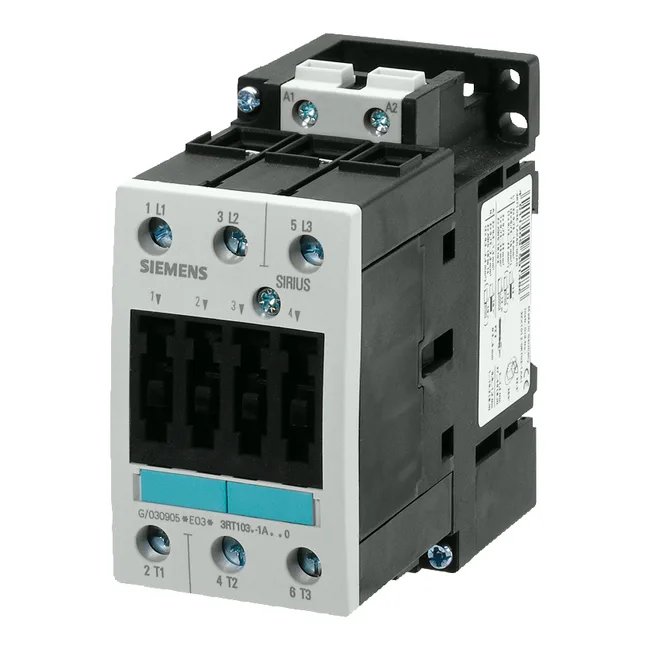
Rated for AC-3 duty at 400 V delivering 15 kW — that is the standard motor-switching category for squirrel-cage induction motors, so this contactor handles a 15 kW motor on a 400 V line. At 500 V the same motor load capability rises to 18.5 kW; at 690 V it drops to 10 kW, reflecting the voltage derate on the switching arc. For reversing or inching duty (AC-4), the contactor is rated 29 A at 400 V. That is the current it can break under the severe switching conditions of plugging or jogging, where the motor is reconnected while still spinning. The AC-4 switching frequency maxes at 250 operations per hour, compared to 1 000 per hour for AC-3 — a direct limit on how fast you can cycle in demanding applications. Auxiliary contacts are rated across the control voltage range: 10 A at 24 V, 6 A at 230 V, 3 A at 400 V, and 0.3 A at 220 V. These are the make/break capacities for the control circuit — interposing relays, PLC inputs, or indicator lamps — and they decline with voltage as the arc energy grows.
Rated for pollution degree 3, meaning it tolerates conductive dust or intermittent condensation typical of industrial enclosures.