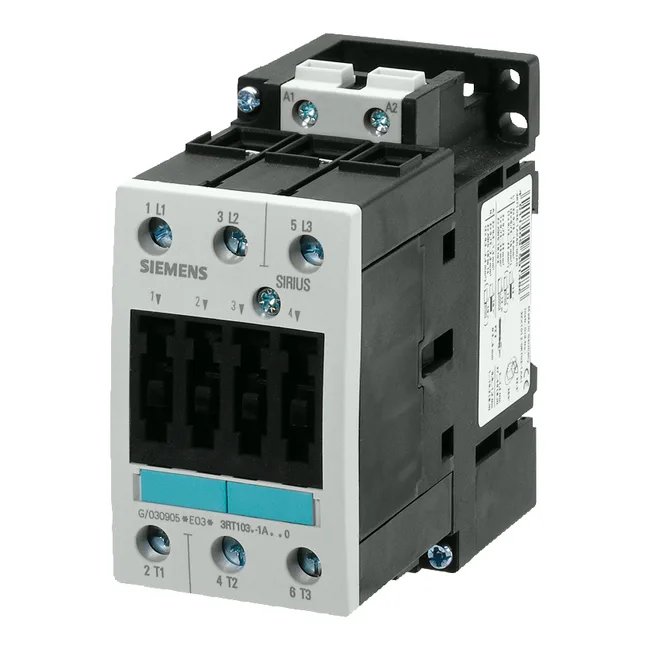
Rated motor power of 18.5 kW at 500 V (50 Hz) and 10 kW at 690 V tells you this contactor handles medium-horsepower induction motors — think pumps, conveyors, and compressors in the 20–30 HP range at 480 V. Switching frequency limits matter when the contactor cycles rapidly. At AC-3 duty it's rated for 1,000 operations per hour, and at AC-4 (plugging/reversing) it drops to 250 per hour. If your application runs a reversing starter or a jogging sequence, the AC-4 ceiling is the one to stay under. The coil operates on 50 or 60 Hz supply, with a pickup voltage range of 0.85 to 1.1 times rated at 60 Hz. That's a standard tolerance, but if your line voltage sags below 85% of nominal during a brownout, the contactor may drop out — something to verify if the panel shares a transformer with large motor starts. Front-side IP20 protection means fingers won't contact live parts during maintenance with the panel door open. The terminal area is rated IP00 — that's open-style, so it requires enclosure protection (the panel itself) against dust or tool contact.
Dimensions are 112 mm high × 85 mm wide × 115 mm deep — that's a compact S2 footprint for a contactor rated at 18.5 kW. Screw-type terminals on the main circuit accept solid wire 2x (0.25–2.5 mm²) and stranded 2x (0.75–25 mm²). The larger stranded range covers the power wiring for the motor circuit; the smaller solid range handles control wiring. Torque values aren't listed here, but standard practice for this terminal class is 2–3 Nm — a torque screwdriver is recommended on the power connections. If the panel sits near a furnace or in a southern enclosure, verify ambient stays under 60 °C; above that, derating applies per the manufacturer's thermal curve.