What it is and where it fits
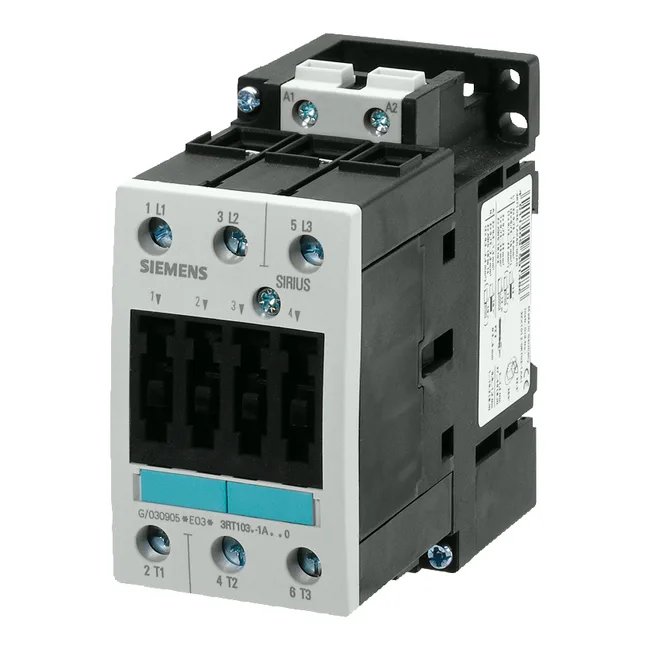
The Siemens 3RT1034-3AV60 is a SIRIUS power contactor in size S2, rated for switching motor loads and resistive loads in industrial control panels. It mounts via screw and snap-on onto 35 mm DIN rail per DIN EN 50022, so it drops into any standard panel layout without adapter brackets. The 55 mm width and 112 mm height keep the footprint compact for the S2 frame, and side-by-side mounting is permitted, meaning you can gang multiple contactors on the same rail without derating for heat buildup.
Key ratings and what they mean for your load
At AC-4 duty (plugging, inching, reversing) the contactor is rated 29 A at 400 V. That is the heavy switching category for frequent motor reversals or jogging — the 250 cycles-per-hour maximum at AC-4 tells you this part is built for that abuse, not just continuous running. For motor starting (AC-3), the contactor handles 18.5 kW at 500 V. That is the standard rating for squirrel-cage motors during start and run, and the 1,000 cycles-per-hour AC-3 rating means it handles frequent starts on a conveyor or pump line. The auxiliary contacts are rated 10 A at 24 V, 6 A at 230 V, and 0.3 A at 220 V DC. The DC rating drops sharply with voltage because DC arcs sustain longer — the listed arcing time of 10 to 15 ms is the window the contactor must clear. For a 24 VDC PLC interlock circuit, the 10 A rating gives plenty of headroom.
Termination and wiring
Main current circuit uses screw-type terminals. The solid wire range is 2x (0.25 to 2.5 mm²) for control wiring, and stranded accepts 2x (0.75 to 25 mm²) for the power loop. At 40 °C, the minimum permissible cross-section is 16 mm² for full rated current — that is a #6 AWG equivalent, so plan your lugging accordingly. The front face carries IP20, meaning finger-safe when installed in an enclosure. The terminal area itself is IP00, so the contactor must live inside a panel or cabinet — not open-air on a machine frame.
Environmental and compliance
Operating temperature range is -25 to +60 °C, with storage from -55 to +80 °C. Pollution degree 3 means it tolerates conductive dust and occasional condensation — typical for industrial floors near machining or packaging lines.
