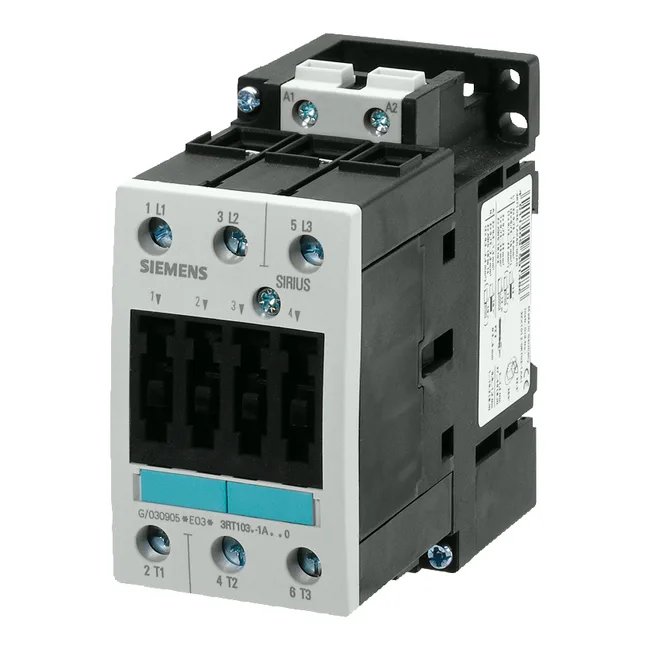
The 18.5 kW rating at 500 V AC-3 tells you it handles standard squirrel-cage motor starting and running up to that power — the AC-3 duty class covers starting and disconnecting motors under load. For more demanding applications like reversing or plugging, the AC-4 rating of 29 A at 400 V gives the thermal capacity for those higher-stress cycles. The 24 VDC coil draws 10 A at rated voltage, with a dropout delay of 20 to 30 ms and arcing time of 10 to 15 ms. That dropout window matters for control logic timing — if your PLC or safety relay needs a fast drop, factor in that 20 ms minimum before the main contacts open.
Side-by-side mounting is supported — no derating gap required for adjacent contactors in the same row. Main power terminals are screw-type accepting 2x (0.75 to 25 mm²) stranded or 2x (0.25 to 2.5 mm²) solid. The minimum 16 mm² at 40 °C tells you the smallest wire gauge for full rated current at elevated ambient. Coil terminals use the same screw clamp range. IP00 on the front and terminals means it's an open device — install inside a panel with at least IP54 enclosure for anything beyond a clean dry location.
Switching frequency and coil data
Maximum switching rates: 1200 cycles/hour at AC-1 (resistive), 750 at AC-2 (slip-ring motors), 1000 at AC-3 (squirrel-cage motors), and 250 at AC-4 (reversing/inching). The AC-4 limit is the binding one for high-duty applications — if your cycle rate exceeds 250 per hour in a reversing crane or conveyor, step up to a larger frame. Coil pickup at 0.7 of rated voltage, dropout at 1.25 of rated. That 0.7 factor means the coil pulls in reliably even if the 24 VDC supply droops.
RoHS compliance date is 05/01/2012, covering the EU RoHS directive.