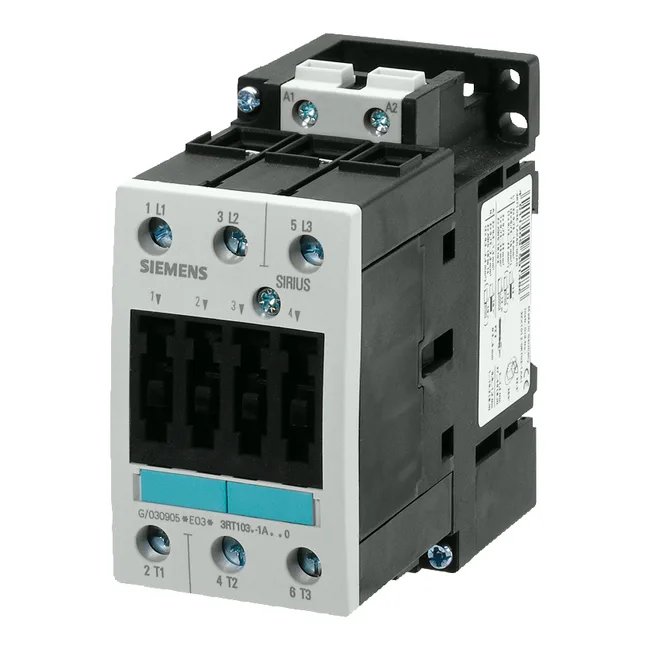
The AC-1 maximum switching rate of 1 200 cycles per hour tells you it can keep up with frequent resistive load switching; AC-4 at 250 cycles per hour covers plugging or inching duty. Coil pickup at 70% of rated voltage (77 VDC) and dropout below that threshold means the control circuit needs a clean 110 VDC supply — verify your DC bus isn't sagging under load. Auxiliary contacts are rated at 24 VDC for 10 A, 110 VDC for 1 A, and 220 VDC for 0.3 A — these numbers govern what pilot devices or PLC inputs you can drive directly without an interposing relay.
Clearance requirements: 10 mm upwards, downwards, forwards, and at the side. That's tight — you can pack these side-by-side (side-by-side mounting is supported) but keep the 10 mm breathing space for arc flash and heat dissipation. Solid and stranded wire ranges: main circuit accepts 2x (0.75 to 25 mm²) stranded or 2x (0.75 to 16 mm²) solid; control circuit takes 2x (0.25 to 2.5 mm²) solid. Strip length follows standard practice for screw terminals — aim for 8-10 mm stripped and torque to the manufacturer's spec.