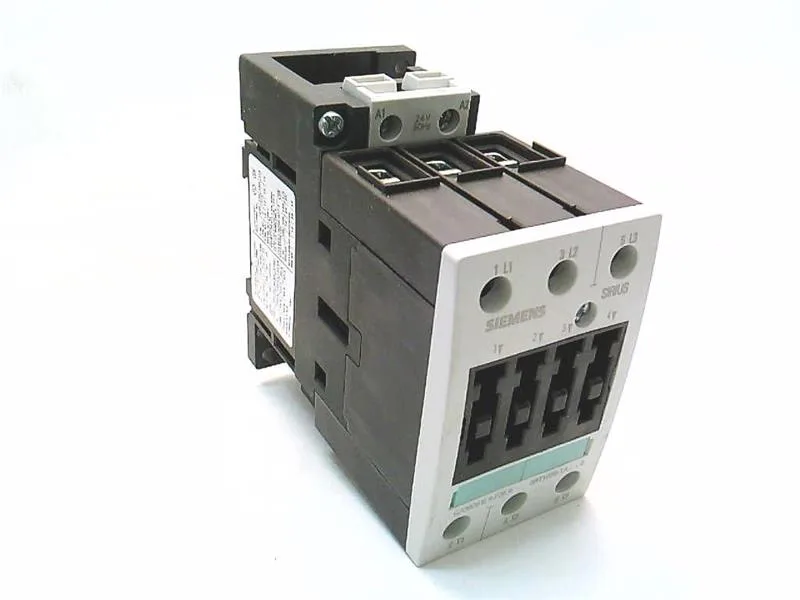
It's a workhorse contactor for the route — 18.5 kW at AC-2 400 V for slip-ring motors, 22 kW at 500 V for standard squirrel-cage induction motors, and 11.4 kW at 690 V for higher-voltage applications. The AC-3 rating at 400 V (not shown in the excerpt) governs the everyday motor-starting duty most panels see. Mechanical life of 10 million operations means it'll outlast the cabinet it's mounted in. That's enough for the power feed on a 22 kW motor circuit.
Environmental Fit for the Panel
IP20 on the front face keeps fingers out; IP00 at the terminals means the wiring compartment is open, so the contactor needs to live inside a cabinet or enclosure.
Switching Speeds and Duty Cycles
AC operating time of 7 to 20 ms and arcing time of 10 to 15 ms give a predictable total break time under 35 ms — fast enough for most motor protection coordination schemes. Maximum operating rates: 1 200 operations per hour at AC-1 (resistive), 1 000 at AC-3 (motor start), and 300 at AC-4 (plugging/inching). The coil is rated for 48 V at both 50 Hz and 60 Hz, with a voltage tolerance of 0.8 to 1.1 times rated at 50 Hz and 0.85 to 1.1 at 60 Hz — so it holds in on a sagging line.