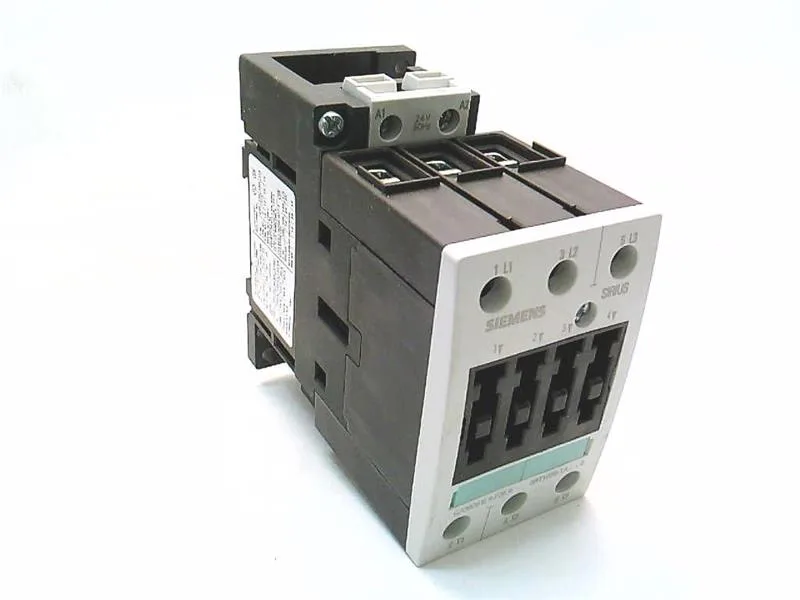
It carries a 110 V 50 Hz / 120 V 60 Hz coil and is rated for AC-2 duty at 18.5 kW at 400 V, making it suited for slip-ring motor or moderate-duty induction motor applications. The operating range spans 0.8 to 1.1 times the rated voltage at both 50 Hz and 60 Hz, so the coil holds in reliably even if line voltage dips 20 %. Operating time at AC is 7 to 20 ms, with arcing time between 10 and 15 ms — tight enough for coordinated motor starter assemblies without excessive contact wear.
For standard squirrel-cage motors (AC-3), the contactor is rated 22 kW at 500 V, and for plugging or inching duty (AC-4) it handles 11.4 kW at 690 V. These three duty ratings let you size the contactor to the exact motor category without over-specifying. Mechanical life is 10 million operations typical, with maximum switching rates of 1 200 cycles/hour in AC-1 (resistive), 1 000 in AC-3, and 300 in AC-4. The AC-4 rate is the limiting factor for reversing or jogging applications — if your cycle rate exceeds 300/h, the contactor will wear prematurely. Auxiliary contact ratings cover both AC and DC control circuits: 10 A at 24 V DC, 2 A at 60 V DC, 1 A at 110 V DC, and 0.3 A at 220 V DC, plus 6 A at 230 V AC and 3 A at 400 V AC. These are the limits for pilot devices, PLC inputs, or relay coils wired through the auxiliary block.
For a BOM line that needs this exact coil voltage (110 V 50 Hz / 120 V 60 Hz) and size S2 frame, the 3RT1035-1AK64 is the direct fit. Sourcing is straightforward through the usual Siemens industrial controls supply chain.
Dimensions are 112 mm high, 55 mm wide, and 164 mm deep. Main circuit terminals are screw-type, accepting solid wires from 0.5 to 4 mm² (2 conductors per terminal) and stranded wires from 0.75 to 25 mm². The control circuit accepts 2x (0.5 to 1.5 mm²) solid or 2x (0.75 to 2.5 mm²) stranded, with a maximum of 2x 4 mm² solid. This range covers most panel wiring from signal-level to motor feeders. The -25 °C lower limit is fine for most indoor industrial panels; if the panel sits in an unheated space below freezing, the contactor still operates.