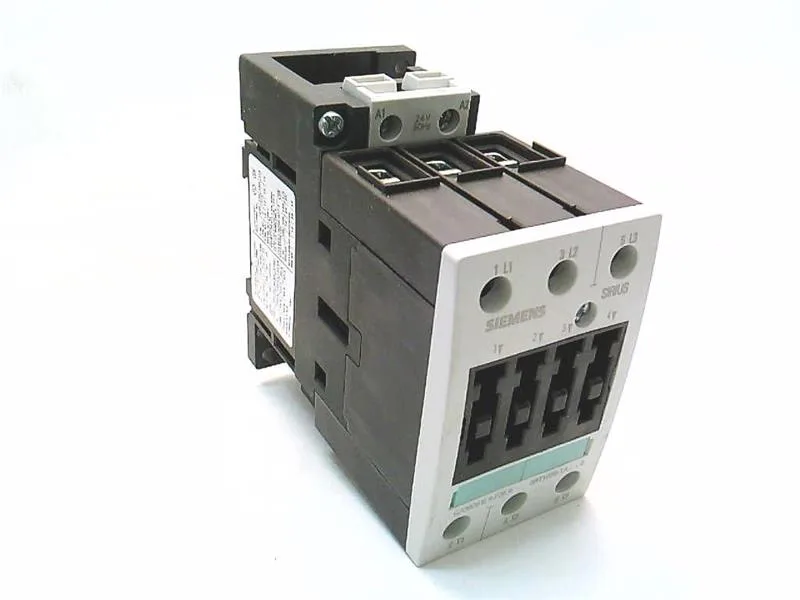
Its headline rating is 18.5 kW at AC-2 duty at 400 V — that's the current it can make and break for slip-ring motor starting, where the load is inductive but not as severe as full plugging. For AC-3 squirrel-cage motors, the rating is 22 kW at 500 V and 11.4 kW at 690 V, covering the common European 400 V and 690 V industrial supplies. At 55 mm wide, 112 mm tall, and 164 mm deep, it fits a standard S2 footprint — plan for the depth when routing wires behind the DIN rail. That's enough for the full-rated motor cable on a 22 kW drive — just make sure the ferrule or ring tongue matches the screw clamp range. The front is IP20 (finger-safe), the terminal area is IP00 (open), so the panel enclosure provides the overall IP rating.
The AC-1 maximum operating rate is 1200 cycles per hour — that's for resistive loads like heaters, where the contactor sees minimal arcing. AC-3 drops to 1000 cycles per hour (standard motor starting), and AC-4 is 300 cycles per hour (plugging or inching). If your application needs frequent jogging, the AC-4 limit is the one that governs contact life, not the AC-3 number. That's the mechanism without load — electrical life will be lower depending on the switching duty and current. For a conveyor line cycling once per minute, the mechanical life alone gives about 19 years of continuous operation. If your panel sits in an unheated warehouse in winter, the storage range covers it; the operating range covers most plant-floor conditions.
Wiring and integration notes
The coil operates at 50 Hz and 60 Hz, with a voltage tolerance of 0.8 to 1.1 times rated at 50 Hz and 0.85 to 1.1 at 60 Hz. That's a standard ±10% band with a slight asymmetry at 50 Hz — the coil holds in at 80% of nominal, drops out below that. Auxiliary contact ratings: 10 A at 24 V, 6 A at 230 V, 3 A at 400 V, 0.3 A at 220 V DC. The DC ratings drop fast with voltage — at 220 V DC it's only 0.3 A, so don't plan to switch a DC solenoid directly without checking the load current against the curve.