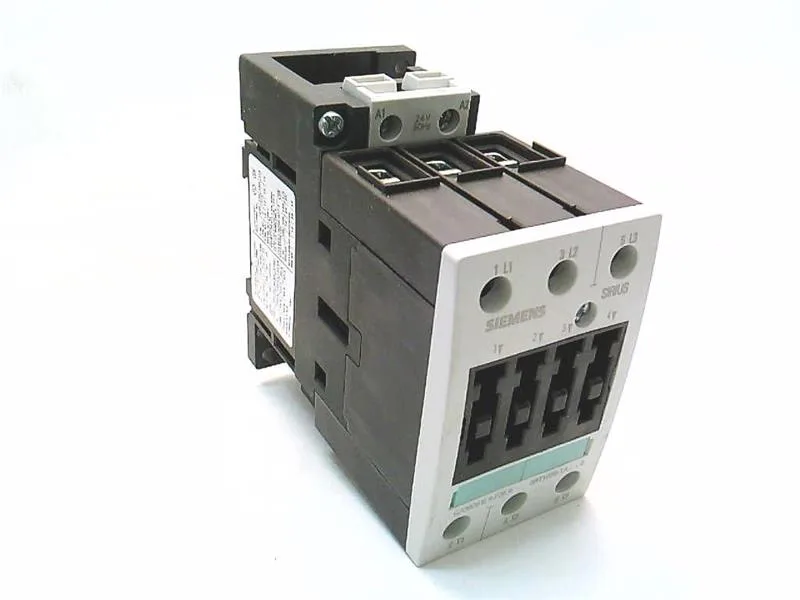
Rated for 22 kW at 500 V in AC-3 duty (standard motor switching), and 35 A at 400 V in AC-4 duty (reversing or inching). For AC-2 duty (slip-ring motors) it delivers 18.5 kW at 400 V. The contactor also carries auxiliary contact ratings: 10 A at 24 V, 6 A at 230 V, 3 A at 400 V — these are the contacts you'd use for PLC feedback or interlocking.
Dimensions: 112 mm high, 55 mm wide, 115 mm deep. Side-by-side mounting is supported. For the main circuit, the minimum permissible cross-section at 40 °C is 16 mm² — that's the wire size you need to carry the rated current without derating. Front face is IP20 (finger-safe), terminal area is IP00 (open).
RoHS compliance date is 05/01/2012.
Switching rates and arc timing
Maximum switching rates: 1200 cycles/hour at AC-1 (resistive), 1000 at AC-3 (motor), 600 at AC-2, and 300 at AC-4. The AC-4 rate is the limiting factor for reversing or jogging applications — if you need frequent reversals, stay under 300 ops/h. These are the contactor's own switching times — they matter for coordinating with upstream short-circuit protection and for sequence timing in safety circuits.