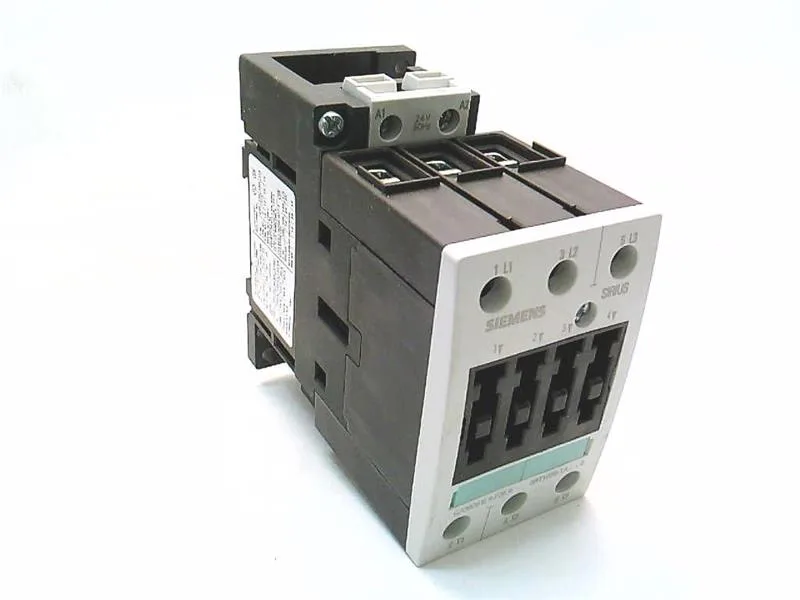
The Siemens SIRIUS 3RT1035-1BB44-3MA0 is a size S2 power contactor rated for motor switching at 22 kW on 500 V and 11.4 kW on 690 V. This is a current-production part, not a phase-out or obsolete item.
At 55 mm wide, 112 mm tall, and 179 mm deep, this contactor fits standard S2 panel cutouts. Side-by-side mounting is supported, so you can gang multiple units without extra spacing.
The AC-3 motor rating of 22 kW at 500 V and 11.4 kW at 690 V tells you the contactor can handle full-load starting and running of standard induction motors at those voltages. For heavy-duty jogging or reversing (AC-4 duty), it's rated 35 A at 400 V — a lower continuous current than AC-3, reflecting the stress of inching and plugging. The AC-2 rating (slip-ring motors) is 18.5 kW at 400 V. Maximum switching frequencies vary by duty: 1 200 cycles/hour for AC-1 (resistive), 1 000 for AC-3, and 300 for AC-4 — so don't expect this part to run a high-speed pick-and-place solenoid at 3 000 cycles/hour.
The coil is 24 V DC rated. Holding current at 24 V is 10 A; at 60 V it drops to 2 A, at 110 V to 1 A, and at 220 V to 0.3 A. DC dropout is 20 to 25 ms. These numbers matter for timing coordination with upstream PLC outputs or safety relays — the dropout delay is long enough that you'll want to sequence power removal if you're relying on fast contact opening.
Main circuit terminals accept solid conductors from 2x 0.5 mm² up to 2x 4 mm², and stranded from 2x 0.75 mm² up to 25 mm². The solid-or-stranded range is 2x 0.75 to 16 mm². At 40 °C, the minimum permissible conductor is 16 mm² — that's the thermal derating floor, not a wiring limit. For control wiring, solid conductors from 0.5 to 1.5 mm² and stranded up to 2.5 mm² are typical. Screw terminals mean you'll need a torque driver on site, not a spring-cage tool.
RoHS compliance substance prohibition date is May 1, 2012, so it meets current EU RoHS requirements.