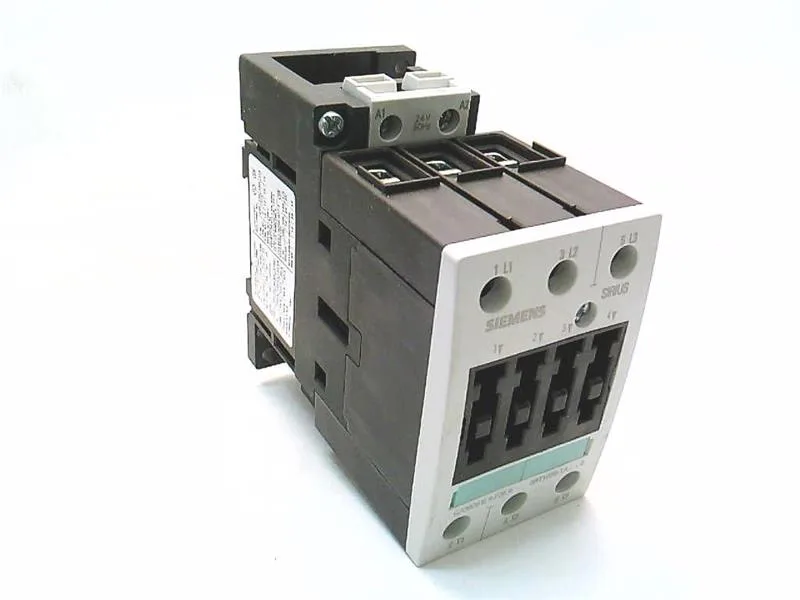
The headline rating to watch is the AC-4 at 400 V: 35 A. That's the contactor's capability for reversing or inching duty — the high-stress switching where the load is still pulling current when the contacts open. For AC-3 motor starting at 400 V, it carries 18.5 kW. At 500 V the motor rating reaches 22 kW; at 690 V it drops to 11.4 kW. These are the numbers that decide fit for a given motor nameplate. Coil-side: the contactor pulls 10 A at 24 V rated value, 6 A at 230 V, and 3 A at 400 V. The arcing time runs 10 to 15 ms; DC dropout takes 20 to 25 ms. Mechanical life is rated at 10 million operations typical, and the switching frequency limits are 1 200 ops/h at AC-1, 1 000 at AC-3, and 300 at AC-4 — the last figure reflecting the heavier arc wear in inching duty.
Side-by-side mounting is permitted, so no derating for ganging in a panel. Terminal capacity: solid conductors accept 2x (0.5 to 1.5 mm²), 2x (0.75 to 2.5 mm²), and max 2x (0.75 to 4 mm²). For the main circuit, the minimum permissible cross-section at 40 °C is 16 mm² — that's the thermal sizing for continuous current, not the terminal's mechanical limit. Pollution degree 3 (conductive pollution typical of industrial enclosures) is assumed, so the IP20 front / IP00 terminal protection is adequate inside a cabinet.
RoHS compliance is documented with a substance prohibitance date of 05/01/2012, covering the EU RoHS directive.