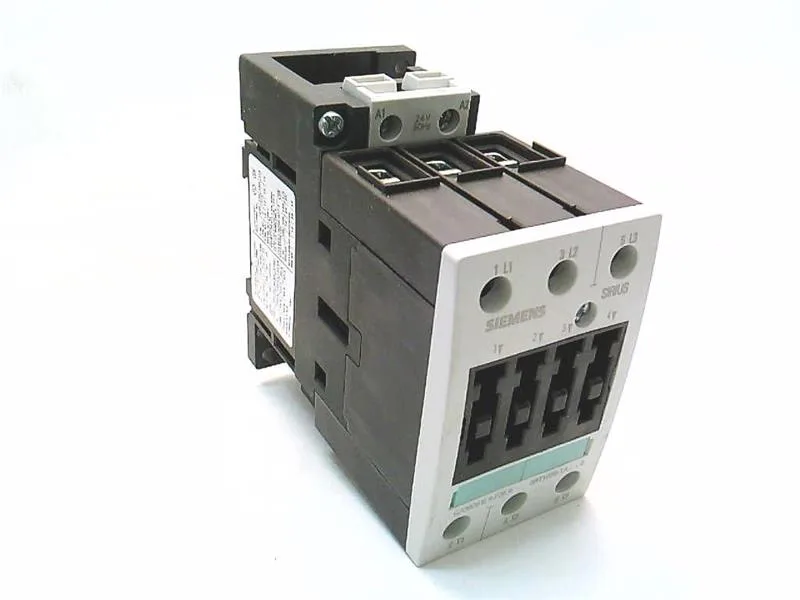
What It Is and Where It Fits
The Siemens 3RT1035-1QB44-3MA0 is a SIRIUS power contactor in frame size S2, designed for switching motor loads in industrial control panels. It mounts via screw and snap-on onto a 35 mm DIN rail per EN 50022, so it integrates directly into a standard panel layout without adapters. Rated for 22 kW at 500 V in AC-3 duty, this contactor handles the inrush and breaking of standard three-phase induction motors up to that power. The AC-4 rating of 35 A at 400 V covers reversing or inching applications where the contactor makes and breaks stalled-rotor current.
Key Ratings and What They Mean for Your Panel
The 55 mm width and 179 mm depth determine the DIN-rail footprint. At 55 mm, it occupies three 18 mm module spaces — standard for an S2 frame. The 112 mm height leaves clearance for a typical 200 mm tall enclosure backplate. Screw-type terminals on the main circuit accept solid conductors up to 2x 4 mm² or stranded up to 2x 25 mm². The minimum permissible cross-section at 40 °C is 16 mm², which governs the smallest wire you can terminate for full rated current — important when paralleling smaller conductors. The contactor is rated for side-by-side mounting without derating, so you can pack multiple units on the same DIN rail without spacing gaps. Pollution degree 3 means it's suited for industrial environments with conductive dust or occasional condensation. Operating temperature range is -25 to +60 °C, with storage from -55 to +80 °C. The IP20 front protects against finger contact; the terminal area is IP00, so live parts are exposed — terminal shrouds or a cover plate are expected in the panel.
Lifecycle and Sourcing Reality
Compliance documentation is in place: the substance prohibition date of 05/01/2012 aligns with RoHS and REACH requirements. No further compliance gaps to flag for EU or UKCA markets.
Mechanical and Electrical Endurance
Mechanical life is typical at 10,000,000 operations — this is the wear-out figure for the moving armature and springs under no-load cycling. Electrical life varies by duty: 1,200 operations per hour at AC-1 (resistive), 1,000 at AC-3 (motor running), and 300 at AC-4 (plugging/reversing). The arcing time of 10 to 15 ms and DC dropout of 20 to 25 ms are useful for coordination studies.
