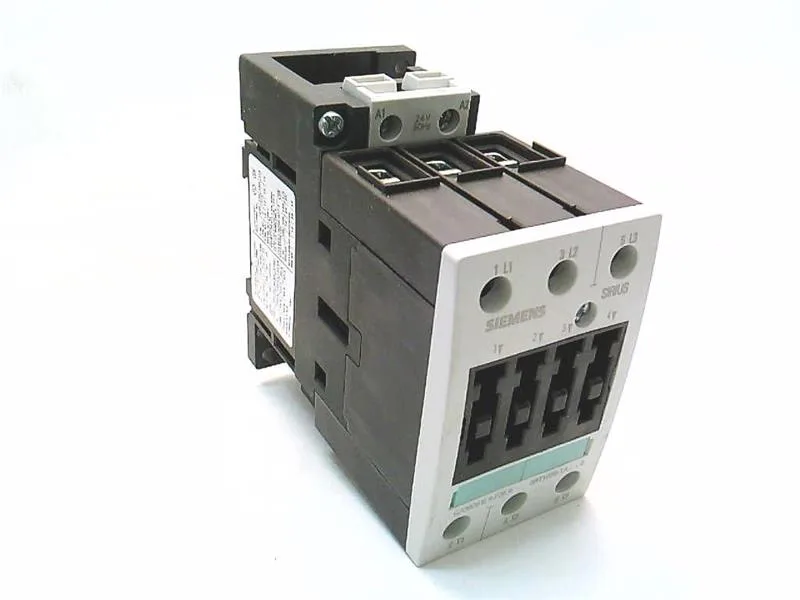
The headline motor ratings tell you what it handles in real duty cycles. At AC-2 duty (slip-ring motors, starting/stopping under load) it switches 18.5 kW at 400 V. At AC-4 duty (plugging, inching, reversing) it carries 35 A at 400 V — that's the heavy-cycling rating that governs service life on reversing or jogging applications. The AC-3 maximum operating rate of 1,000 cycles per hour means it can keep up with a fast conveyor or pump start sequence without overheating the coil or arc chamber. For the control circuit, the coil is rated 24 V at 50 Hz, drawing 10 A at that voltage. The auxiliary contact ratings cover 60 V (2 A), 110 V (1 A), 220 V (0.3 A), and 230 V (6 A) — so it handles a mix of PLC outputs and pilot devices on the same coil circuit. Arcing time runs 10–15 ms, and the pickup/dropout delay at AC is 7–20 ms, which matters when coordinating with upstream short-circuit protection or safety relays. The enclosure protection is split: IP20 on the front (touch-safe for panel builders) and IP00 at the terminals — so the wiring zone expects enclosure-level protection from the panel itself.
Solid conductors accept 2x (0.25–2.5 mm²); stranded accepts 2x (0.75–25 mm²). The minimum permissible conductor at 40 °C is 16 mm² — so for full-rated motor loads you'll want at least that cross-section on the power path.