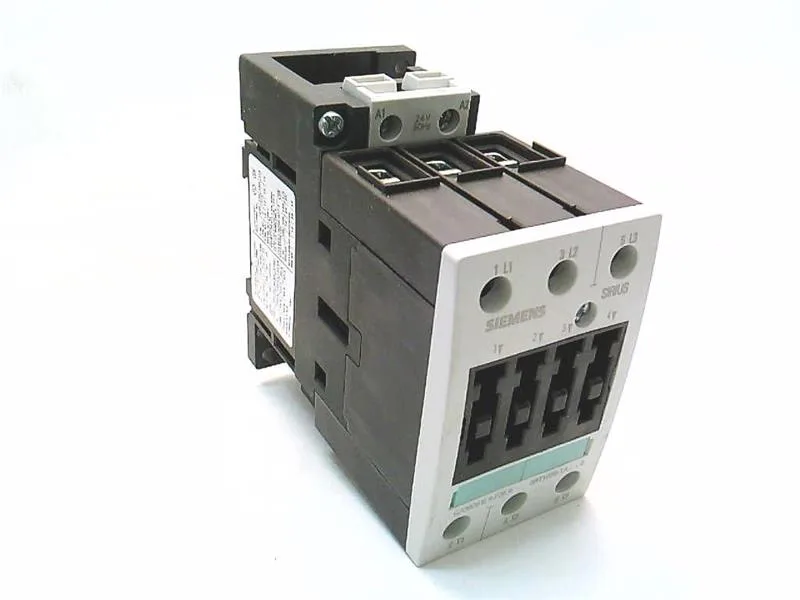
It carries a 35 A AC-4 rating at 400 V — that's the heavy-duty reversing or plugging duty cycle, where the contactor makes and breaks stalled-rotor currents. For the more common AC-2 duty (slip-ring motor starting), it's rated 18.5 kW at 400 V. The 55 mm wide body snaps onto a 35 mm DIN rail per EN 50022, and the screw-type main terminals accept up to 16 mm² stranded wire.
What the ratings mean in the panel
The AC-4 current rating is the one that matters for a reversing starter or a crane hoist — the contactor sees full locked-rotor current on every transition. 35 A at 400 V is roughly a 15 kW motor in that duty. The AC-2 rating (18.5 kW at 400 V) covers slip-ring motor controllers where the starting current is lower. Side-by-side mounting is allowed — no derating gap needed between units on the rail.
Coil data: at 50 Hz, the operating range is 0.8 to 1.1 times rated voltage. The contactor is rated for 110 V at 50 Hz. Switching times: 7 to 20 ms for the armature (make/break), with an arcing time of 10 to 15 ms. Auxiliary contact ratings cover 24 V (10 A) through 220 V (0.3 A) — enough for PLC-level signal switching without an interposing relay in most cases.