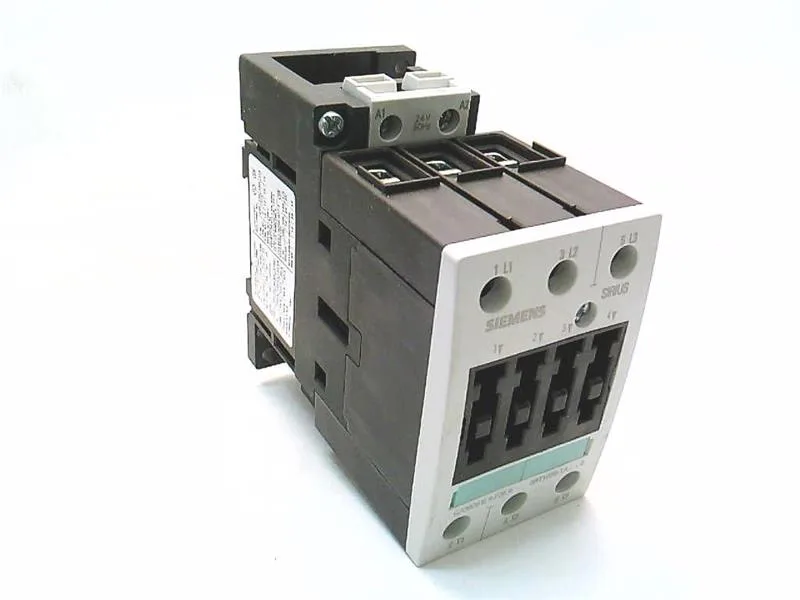
The main current circuit uses screw-type terminals, accepting solid conductors 2x (0.25... 2.5 mm²) and stranded conductors 2x (0.75... 25 mm²). This terminal range covers typical motor feeder wiring from control to power circuits. Rated for 50/60 Hz operation, the contactor carries a mechanical life of 10,000,000 cycles typical, making it suitable for high-duty-cycle applications like conveyors or pumps where frequent starts are expected.
For AC-3 squirrel-cage motor starting, the 500 V rating supports 22 kW, and at 690 V it supports 11.4 kW — so the voltage derating is significant and must be checked against your motor nameplate. Switching frequency limits are: AC-1 resistive loads up to 1,200 operations per hour, AC-3 motor loads up to 1,000 ops/h, and AC-4 plugging/reversing up to 300 ops/h. If your application requires frequent jogging or inching, the AC-4 limit governs the maximum rate. The auxiliary contact ratings at 24 V is 10 A, at 110 V it is 1 A, and at 220 V it drops to 0.3 A — this is the DC switching capability for control circuits. For AC auxiliary loads at 230 V the rating is 6 A, and at 400 V it is 3 A. Use the DC curve for relay or PLC interface coils, not the AC figure.
The contactor is rated IP20 on the front and IP00 at the terminals, meaning the enclosure protects against finger contact on the front but the terminal area is unprotected. In a panel with IP54 or higher rating, this is fine — the panel enclosure provides the terminal protection. Dimensions: 112 mm height, 55 mm width, 115 mm depth.