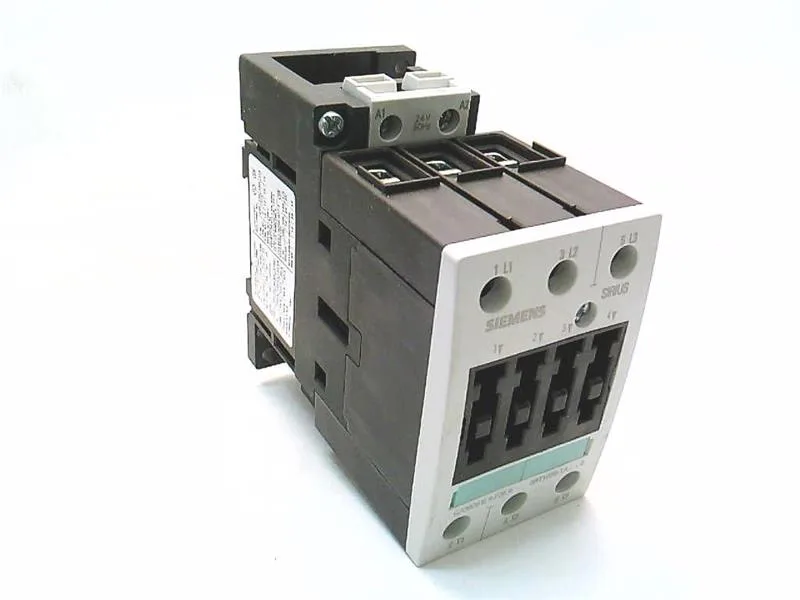
It is rated for 22 kW at 500 V in AC-3 duty, which covers the majority of standard induction motor applications — pump, fan, conveyor, compressor — up to that power level. The contactor also carries an AC-2 rating of 18.5 kW at 400 V for slip-ring motor starting, and 11.4 kW at 690 V for higher-voltage installations. The main current circuit uses screw-type terminals, accepting solid conductors up to 2x 2.5 mm² and stranded up to 2x 25 mm², giving flexibility for both control wiring and power cabling.
The 22 kW AC-3 rating at 500 V is the headline motor-switching figure — it tells you the contactor can make and break locked-rotor current for a motor of that power. For a 400 V supply (common in EU panels), the AC-3 rating is typically lower; the 18.5 kW AC-2 figure at 400 V gives a reference for the same voltage class. The 690 V rating of 11.4 kW confirms suitability for 690 V line supplies, often found in heavy industrial or mining installations. Mechanical life is rated at 10 million operations typical, with electrical endurance varying by duty: 1200 cycles/h at AC-1 (resistive), 1000 cycles/h at AC-3 (motor), and 300 cycles/h at AC-4 (plugging/inching). The AC-4 rate is the limiting factor for frequent reversing or jogging applications — if your cycle rate exceeds 300 per hour in AC-4, you need a larger contactor or a different topology.