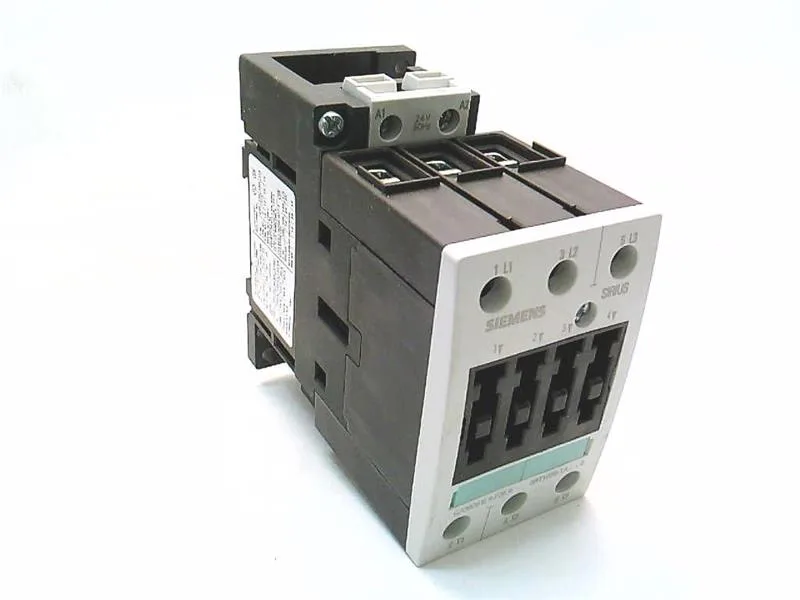
The main current circuit uses screw-type terminals, accepting 2x (0.25... 2.5 mm²) solid or 2x (0.75... 25 mm²) stranded wire, with a combined capacity of 2x (0.75... 16 mm²). At 40 °C, the minimum permissible wire size is 16 mm². The front of the device carries an IP20 rating; the terminal area is IP00, meaning the connection points are not touch-safe — panel builders must account for this in the gland plate and cover design. Pollution degree 3 (conductive pollution) is specified, so it expects a controlled environment or conformal coating if used in dusty or humid conditions.
Motor Switching Performance and Duty Ratings
This contactor is rated for AC-2 duty (slip-ring motors, wound-rotor) at 18.5 kW at 400 V, and for AC-4 duty (plugging, inching) at 35 A at 400 V. For AC-3 duty (squirrel-cage motors), it handles 22 kW at 500 V and 11.4 kW at 690 V. The AC-1 resistive load rating supports up to 1,200 switching cycles per hour, while AC-4 drops to 300 cycles per hour — a direct reflection of the electrical stress during reversing or jogging operations. The operating factor at 50 Hz is 0.8... 1.1. For DC switching, it handles 10 A at 24 V, 2 A at 60 V, 1 A at 110 V, and 0.3 A at 220 V — these are the break capacities, so verify the load inductance against the contactor's DC-1 or DC-3 curve if switching DC motors or solenoids.
The S2 frame measures 55 mm wide, 112 mm high, and 115 mm deep. Side-by-side mounting is permitted, which saves rail space when grouping multiple contactors for a multi-motor section. The screw-type terminals accept the wire ranges listed above — for the main circuit, the combined solid/stranded capacity of 2x (0.75... 16 mm²) is the practical limit for paralleling conductors. The front IP20 rating means the operator interface is finger-safe; the terminal area IP00 means the connection points are exposed and require enclosure protection.