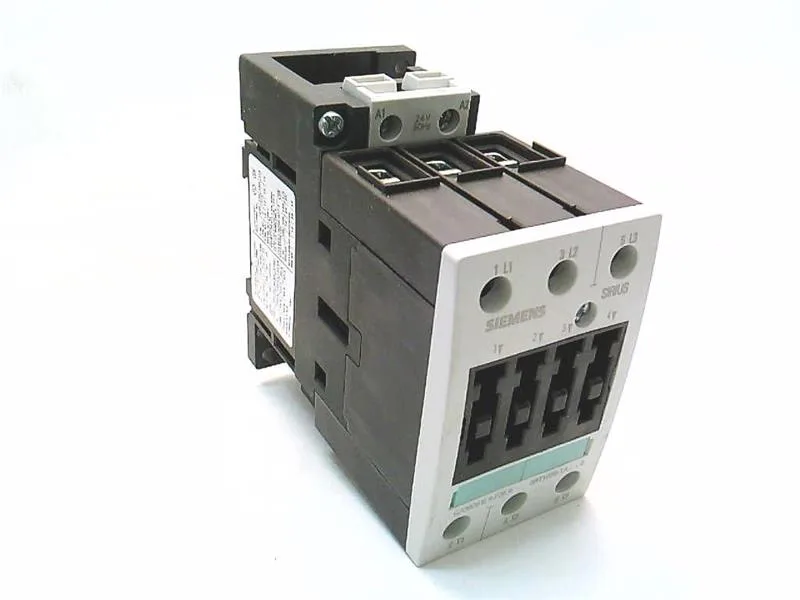
The Siemens 3RT1035-3XF00-0GA0 is a SIRIUS size S2 power contactor with a 110 V 50 Hz coil, rated for switching motor loads up to 22 kW at 500 V in AC-3 duty, and 18.5 kW at 400 V in AC-2 duty. It carries a 35 A AC-4 rating at 400 V for reversing or inching applications that hammer the contacts. The auxiliary contact block handles 10 A at 24 V, 6 A at 230 V, and 3 A at 400 V — enough for a small PLC input or a holding interlock. This is the part you grab when a motor starter on a conveyor or pump loses its main contactor and you need a drop-in with screw terminals and a standard 110 V AC coil. The AC-3 rating is the workhorse motor-switching number; AC-4 tells you it can handle plugging or jogging where the contacts make and break under full load current.
The footprint is 55 mm wide, 142 mm high, 130 mm deep — size S2 frame, which is a common mid-range contactor body that fits most motor starter assemblies. Terminals are screw-type on the main current circuit, accepting 2x solid conductors from 0.25 to 2.5 mm² or 2x stranded from 0.75 to 25 mm². The auxiliary terminals handle 2x (0.75... 16 mm²) solid or stranded.
Environmental and lifecycle reality
Coil tolerance is 0.8 to 1.1 times rated voltage at 50 Hz, so the 110 V coil will pick up reliably down to about 88 V and hold in at up to 121 V. Dropout time on DC is 20 to 25 ms; arcing time across the main contacts is 10 to 15 ms. Shock resistance is 15g for 5 ms in AC operation, 8g for 10 ms — tough enough for most industrial vibration environments.
This is a current-production Siemens SIRIUS contactor, sourced through independent distribution. For a line-down situation, this part is specified into the BOM and quoted to order — no deferral needed.