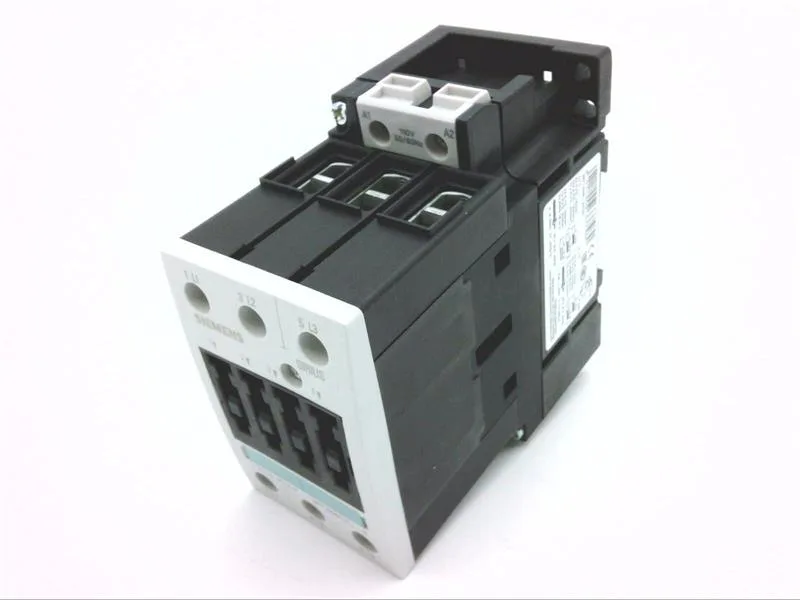
The S2 footprint (55 mm wide, 112 mm tall, 115 mm deep) snaps onto standard 35 mm DIN rail per DIN EN 50022, with screw-type terminals for the main circuit.
AC-2 at 400 V: 22 kW. That is the motor power the contactor can handle under slip-ring motor starting — a harder duty than AC-3 (standard squirrel-cage) because the arcing time is longer. For reference, the contactor's own arcing time is rated 10 to 15 ms. The AC-3 maximum switching frequency is 800 cycles per hour, while AC-4 (inching/plugging) drops to 300 cycles per hour — so if your line runs frequent reversals, check the duty cycle against those limits. The control coil range is wide: 0.8 to 1.1 times the rated voltage at 50 Hz, 0.85 to 1.1 at 60 Hz. That means a 110 V coil (the rated value) holds in down to about 88 V at 50 Hz — good for brownout ride-through on a marginal supply. Pick-up time at AC is 7 to 20 ms. Auxiliary contact ratings: 10 A at 24 V, 6 A at 230 V, 3 A at 400 V, 0.3 A at 220 V DC. The contactor body is IP20 on the front; the terminals are IP00 — so the terminal area needs to be inside an enclosure with at least IP54 to keep dust and moisture out.
Side-by-side mounting is allowed — no gap needed between adjacent units, which saves rail space in a dense panel. The screw terminals accept: solid 2x (0.5 to 1.5 mm²), 2x (0.75 to 2.5 mm²), max 2x (0.75 to 4 mm²); stranded 2x (0.75 to 25 mm²); solid or stranded 2x (0.75 to 16 mm²). For the main circuit, use the stranded range up to 25 mm² — that covers the full rated current for a 22 kW motor at 400 V.